
School Bus Safety:
Read the Road,
Not Just the Stop Arm
School bus safety depends on more than flashing lights. Compare state stopping rules, waiting areas and visibility around the bus.
NHTSA marked October 19–23 as National School Bus Safety Week in 2026. That campaign has ended, but its central driving problem returns whenever classes meet: a large, conspicuous vehicle can conceal a small pedestrian. Seeing the yellow bus is only the first part of seeing the situation. The sidewalk, the opposite shoulder, a driveway and the space immediately in front of the bus may all matter before your car moves again.
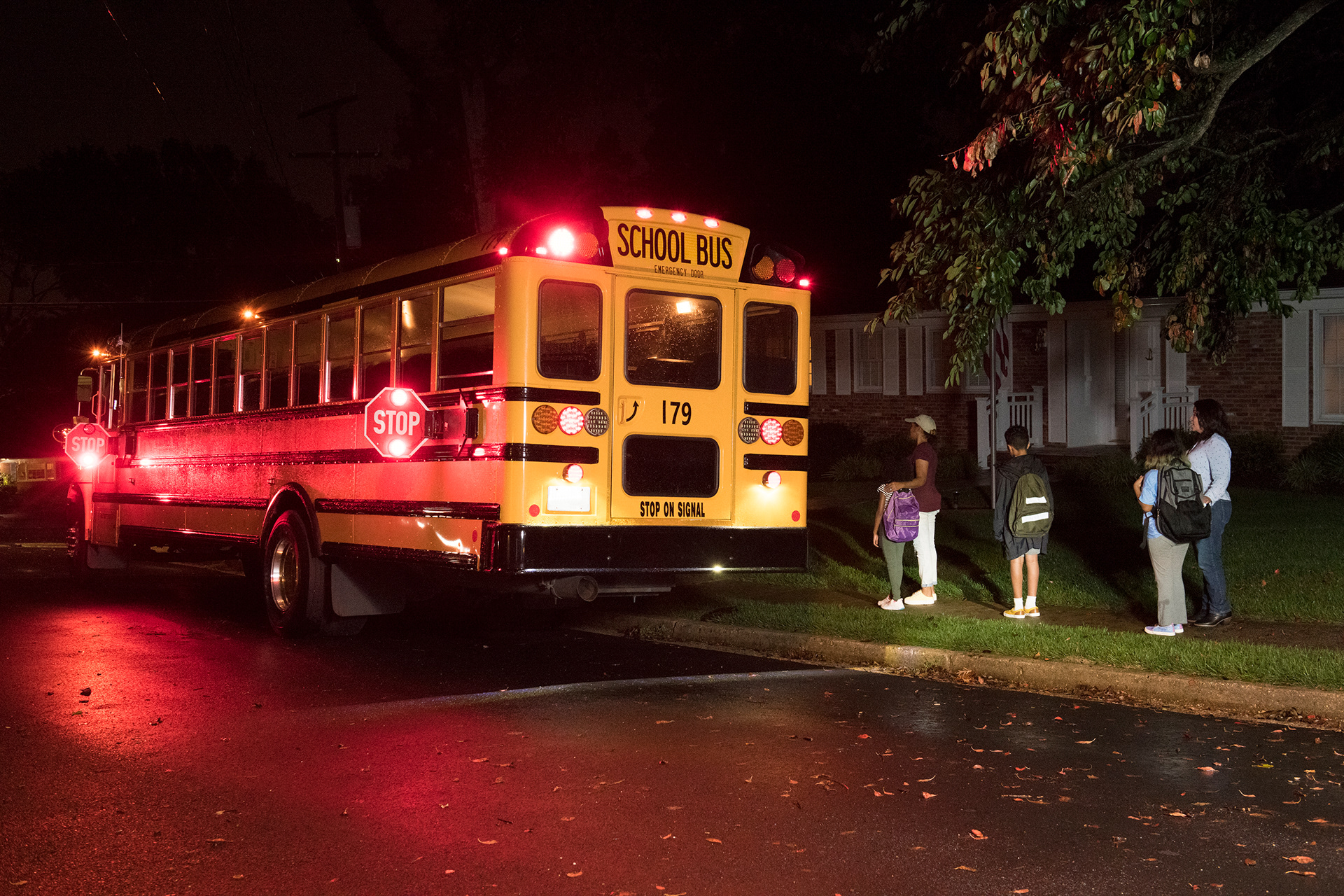
This is a guide to the decisions an ordinary U.S. motorist can make, and to the questions a household can take to a school transportation office. It draws on federal safety guidance and current state driver instructions, rather than a road test or observation of a particular school district. The photographs are NHTSA educational scenes; they do not document a new crash, a specific family's commute or the performance of a current bus model.
Vehicle condition is a separate part of the commute. Our winter car-check guide examines tires and visibility before the first freeze; this report focuses on the people and rules around a school bus.
Start with the sequence, not the inconvenience
NHTSA distinguishes the bus's warning stages. Flashing yellow lights tell approaching drivers that it is preparing to stop for children. The correct response is to slow and prepare to stop, not to calculate whether there is enough time to squeeze past. Flashing red lights and an extended stop arm identify the stopped loading or unloading phase. For a driver required to stop, that is a complete stop, not a slow roll that leaves the child guessing whether the car will yield.
The agency's general guidance says to wait until the red lights cease, the stop arm retracts and the bus begins moving before driving again. State instructions and a police officer's directions govern the actual road situation. A child may still be nearby when the visible transaction appears finished, so restarting is a separate observation task. Look around the bus and along the curb before accelerating. The bus driver checking mirrors is not a substitute for the motorist checking the space in front of their own vehicle.
A useful mental change is to treat the approach as a developing pedestrian crossing. If you wait until a stop arm fills the windshield, you have discarded the earlier information: the bus slowing, children gathering, a known stop location and the warning lights. Leaving room before the stop preserves both your view and your ability to respond smoothly. It also avoids turning an expected school-day pause into an abrupt maneuver for the traffic behind you.

The opposite side is a state-law question
Drivers should not import a rule remembered from another state. New York DMV explicitly says that traffic approaching a stopped school bus with flashing red lights must stop on two-lane roads, multilane highways and divided highways. It instructs motorists to stop at least 20 feet away. A median in New York therefore is not a reason to assume the opposite-direction motorist can continue.
California's handbook gives a different instruction for the opposite side: a driver does not need to stop when the school bus is on the other side of a divided or multilane highway with two or more lanes in each direction. That is a specific California exception, not a national permission and not a permission for a driver following behind the bus to pass it. Read the current handbook for the state where you are driving, including what road layouts qualify.
These examples show why a national slogan and a local legal decision do different jobs. The slogan keeps attention on children; the state rule tells a driver how the road configuration changes the obligation. If your regular trip crosses a state line, make that comparison before the commute rather than while approaching flashing lights. Avoid an improvised lane change to escape a line of stopped vehicles. Traffic in the adjacent lane may be stopped for someone your current position does not reveal.
What the national numbers actually count
NHTSA's current campaign page reports 962 fatal school-bus-related crashes and 1,069 deaths during 2015–2024. The word related matters. Those totals are not a count of children killed while riding inside school buses. They include people in other vehicles and people outside vehicles, and the period covers ten years rather than one school year.
Among 204 school-age children killed in those crashes, the agency lists 39 school-bus occupants, 78 occupants of other vehicles, 77 pedestrians, seven bicyclists and three other nonoccupants. Separately, the 119 school-bus occupants killed across all ages comprised 49 drivers and 70 passengers. These categories should not be combined as if every passenger were a school-age child, or presented as separate totals to add to the overall 1,069.
The same source says occupants of other vehicles accounted for 70 percent of those killed in school-bus-related crashes. That is a reminder to motorists that sharing space safely protects more than people stepping off the bus. It is not a per-mile risk comparison, because the table does not supply the exposure needed to calculate a driver's chance of a crash. A ten-year fatality count describes consequences and populations; it does not identify the cause of every event.
The practical interpretation is narrower and more useful than a frightening headline. School transportation has substantial protections for riders, yet the transition between the vehicle and the street deserves separate attention. A family deciding how to reach a stop and a driver approaching that stop are addressing the same physical boundary from opposite directions. Improving one side does not make the other side irrelevant.

A stop location is more than a pin on a map
NHTSA's route-planning toolkit asks planners to consider the student's path to a stop, the waiting area and the direction of the bus route together. A short walk on a map can still include an uncomfortable crossing or a shoulder without useful separation from moving traffic. Conversely, a route that looks slightly less direct may allow boarding without crossing the roadway. Distance alone does not describe the safety of the journey.
For a parent raising a concern, a precise description is more useful than a request to move the stop closer. Identify the direction from which the child arrives, where the group actually waits, which part of the road must be crossed and what blocks the view. Explain whether the difficulty occurs in the morning, afternoon or both. The same physical stop can work differently when the direction of travel reverses or when students approach from another street.
NHTSA encourages minimizing crossings, particularly on high-speed roads, and emphasizes coordination when crossings cannot be avoided. A household should not independently relocate a stop, stand in the roadway to direct traffic or create a new boarding routine without the transportation office. The district must consider the bus's approach, other assigned students and its operating rules, not only one family's most convenient spot.

Three different views must line up
The person driving toward a stopped bus, the bus driver and the waiting child do not have the same view. A parked SUV may hide a small student from an approaching car while leaving that student visible from the higher bus seat. A hedge can hide an approaching vehicle from the waiting area even when the vehicle's driver sees the roof of the bus. Calling a location visible without naming the observer can miss the hazard.
The federal planning guidance identifies vegetation, parked vehicles, signs, poles and structures as possible obstructions. Curves and hills also change the distance over which motorists can recognize a stop. A driver cannot fix the road geometry while passing through, but can respond to limited visibility by reducing speed and keeping attention on the approaches. Assuming a familiar street is clear because it was clear yesterday is not an observation.
For a concern that persists, record the location and obstruction from a safe place and send it through the district's established channel. Avoid publishing children's names, home addresses or daily schedules with a photograph. The useful evidence is the sight line and the road condition, not a child's identity. Transportation staff can then consider whether a change in placement, vegetation management, routing or coordination with road officials is appropriate.

The waiting area has a capacity
A bus stop must work for the actual group assigned to it. NHTSA's toolkit treats the number of students and the available waiting area as connected decisions. A narrow patch that appears sufficient for one child can put a larger group near moving traffic. A waiting area also has to connect to a usable approach path; a seemingly generous grassy space is not helpful if reaching it creates another unsafe crossing.
Parents can rehearse where to wait and how to reach that place without treating every nearby surface as interchangeable. NHTSA recommends arriving at least five minutes early and waiting at least ten feet, described as five giant steps, from the curb. Those instructions reduce the incentive to run toward an arriving bus and keep the waiting group away from its immediate movement. Follow the district's specific stop arrangement and ask about a location where the recommended separation is not available.
Drivers passing a waiting area before the bus arrives should still expect a school-day pedestrian environment. The stop arm is a signal on the vehicle, not the moment children suddenly begin to exist beside the street. Someone may be walking toward the group, and a parked vehicle can conceal that approach. Looking only for the bus's lights narrows attention at precisely the place where a wider scan is useful.

Boarding is a communication task
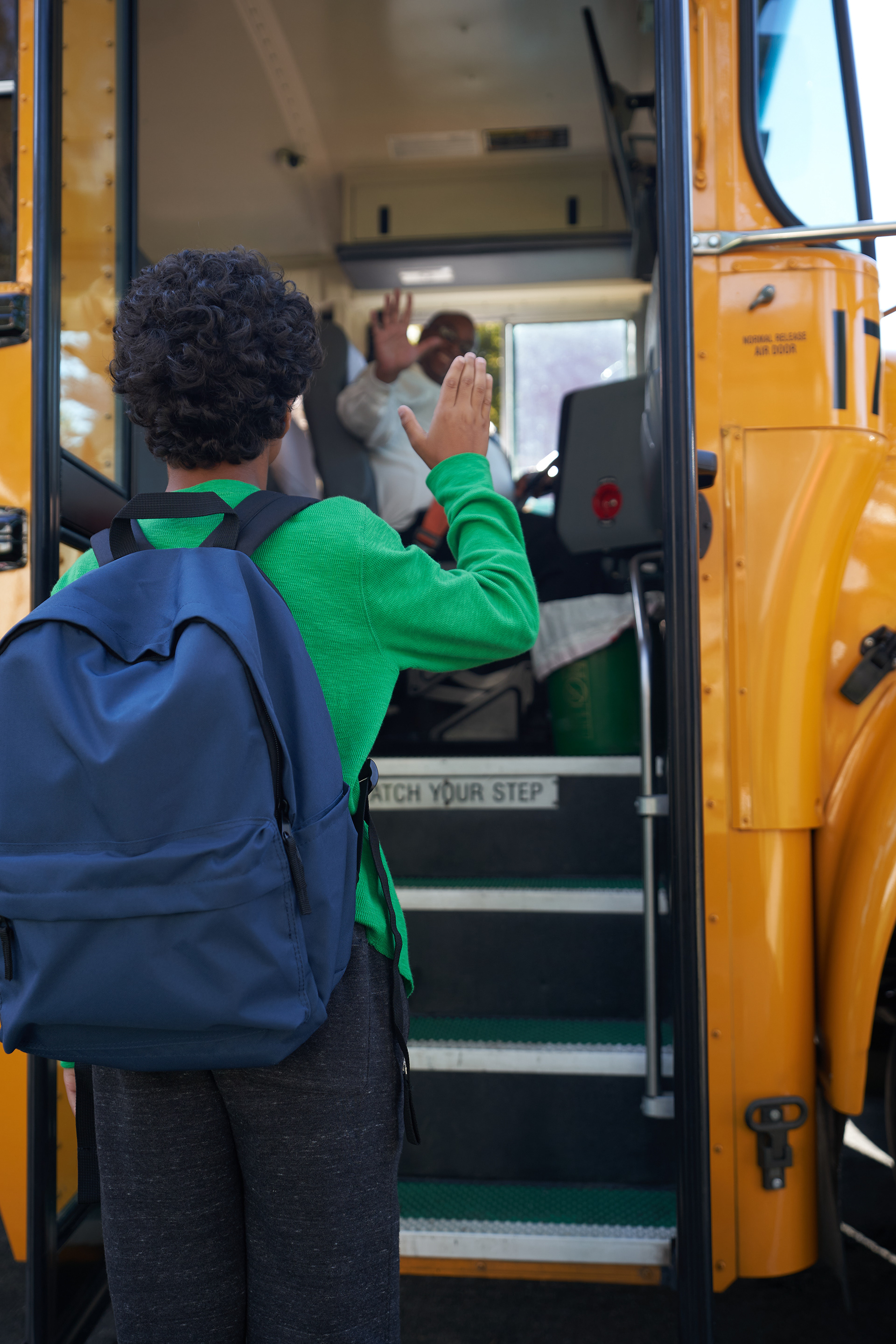
For students, the stop is not complete when the bus reaches the curb. NHTSA says to wait for the vehicle to stop fully, for the door to open and for the driver's permission before getting on or off. It also recommends using the handrail. The sequence gives the driver a chance to control the transition and gives the child a stable way to negotiate the steps.

A photograph of an open doorway cannot establish that an entire loading procedure is safe. It freezes one part of a sequence, while real boarding depends on the driver's instruction, the position of surrounding traffic and the students waiting behind. That is why families should practice the actual routine taught by their district rather than invent a signal based on a poster or a wave seen in a different community.
For an outside motorist, this exchange is a reason for patience, not a chance to go around. A child may pause on a step, need an instruction repeated or move at a different pace. The driver handling that exchange has responsibilities inside and outside the bus at once. Leaving the loading space undisturbed lets the communication finish without adding another moving vehicle to the decision.

Crossing in front is not permission to hurry
NHTSA tells children never to walk behind a school bus. When crossing in front is necessary, its guidance calls for moving along the sidewalk or roadside to a point at least ten feet ahead, then making eye contact with the driver before crossing. The purpose is to remain visible rather than pass through the area immediately against the bus. Families should pair the federal guidance with their district's crossing instructions and designated route.
Visibility to the bus driver does not make every other lane safe. The child and driver must follow the crossing procedure, while surrounding motorists remain responsible for stopping when required. A driver in a passenger car should not wave a child into the roadway as if that gesture controls all traffic. Another vehicle can approach from a direction the waving motorist has not checked or cannot see.
Dropped property creates a different problem. NHTSA advises children to tell the bus driver if an item falls near the vehicle rather than reach for it themselves. An adult preparing a younger student can rehearse that simple instruction with a bag or book before the trip. The important action is asking for help, not deciding whether the object looks close enough to retrieve quickly.

Inside protection does not extend onto the street
Large school buses use a protective seating concept known as compartmentalization: closely spaced, strong seats with energy-absorbing backs help manage crash forces. NHTSA also points to visibility features, cross-view mirrors, stop arms, structural standards and rollover protection. Those are features of a regulated vehicle system, not evidence that any collision would be harmless.
The federal agency distinguishes smaller buses with a gross vehicle weight rating of 10,000 pounds or less, which must have lap or lap-and-shoulder belts at designated seating positions. State and local requirements and the equipment on an individual bus can differ, so a family should ask its operator about the actual vehicle and follow instructions for the restraints provided. A photograph of a bus interior cannot establish the full equipment specification or the policy for another fleet.
Most importantly, protection provided by seats does not follow a child out of the door. That changes the relevant question from how the vehicle protects a seated passenger to how the street protects a pedestrian. Stop placement, communication, traffic behavior and the route home all become part of the safety system. Treating the bus as safe should lead to careful loading, not complacency around it.

A useful report is specific and safely made
If a motorist sees a dangerous pass, the first responsibility is to keep control of their own vehicle and avoid creating another hazard. Do not chase the vehicle, take a photograph while driving or turn a confrontation into part of the children's loading area. Once safely stopped, use the appropriate local reporting channel; an immediate threat may require emergency assistance. Enforcement procedures and camera programs are jurisdiction-specific.
For a recurring concern, separate what you observed from what you inferred. A location, approximate time, direction of travel and description of the maneuver can help an agency understand the pattern. An accusation about a driver's motive is not necessary. Likewise, a report that vegetation blocks a view should identify the obstruction rather than assume the district has ignored it. Clear observations make it easier for the responsible people to examine a correctable condition.
The end of October's campaign is a sensible time to test the household routine against the real school day. Check the state rule, ask whether the waiting area still works and rehearse the boarding and crossing sequence. For the driver with no children on that bus, the commitment is simpler: approach it as a place where people will move, not merely as a slower vehicle. The stop arm is the visible instruction. The safe space around it is the job.






Comments
Post a Comment