
Veterans Day 2026
at national parks
Plan Veterans Day 2026 at national parks: who gets free entry, what military passes cover and which reservations, routes and facilities need checking.
The National Park Service’s current entrance-pass calendar lists Wednesday, November 11, as its remaining 2026 fee-free date after October 27. That Veterans Day entrance-fee waiver applies to U.S. citizens and residents—not every visitor—and does not erase reservations or camping charges. For a family planning a day outdoors or a visit to a military memorial, the practical question is whether the people, route and activity on the itinerary are covered. A national fee calendar is not a national operating schedule. A road into a park can close for the season before the holiday; a memorial can be free every day while its parking lot charges; a boat program can require a separate reservation even when the grounds outside it do not.
This guide separates those decisions using the NPS’s current pass rules and individual park instructions. It is an independent review of published public information, not a report from a site visit. The examples are deliberately different: a Washington memorial, Pearl Harbor, Yellowstone’s winter road network, Rocky Mountain’s visitor infrastructure and Petrified Forest’s short trails. They show why there is no single “free national parks” itinerary that works for every household.
One holiday, several kinds of eligibility
Start with the current NPS entrance-pass page, rather than an old holiday roundup. It says the 2026 waiver is for U.S. citizens and residents; its nonresident section uses the more specific wording “citizens and permanent residents.” The separate nonresident-fee FAQ describes resident-pass eligibility checks and lists a U.S. passport, state or territory driver’s license or state ID, or Permanent Resident Card as acceptable documentation. Travelers whose situation does not fit clearly should ask the destination about its requirements before departure.
Do not confuse that general fee-free day with the Military Lifetime Pass. A U.S. resident does not have to be a veteran to benefit from the November 11 entrance waiver. Conversely, an eligible veteran does not have to wait until Veterans Day to use a military pass. The holiday provision is a date-specific waiver; the pass is a continuing benefit with its own eligibility and coverage. Neither grants a reservation, an open road or priority boarding.
The distinction also matters when a household hosts relatives from overseas. At 11 named parks, the 2026 nonresident charge is $100 per non-U.S. resident age 16 or older, in addition to ordinary entrance charges, unless valid pass coverage applies. The list includes Yellowstone, Grand Canyon, Rocky Mountain and Yosemite. A free-entry date does not itself remove that nonresident charge. However, the NPS FAQ also says valid America the Beautiful passes and park-specific annual passes cover entrance and nonresident fees for the passholder and passengers in a private vehicle, or the permitted party at per-person sites. Check the actual pass and mode of entry before calculating a mixed group’s bill.
The military pass is useful beyond November 11
Sometimes the best fit is already free
The Vietnam Veterans Memorial is an important counterexample to the idea that November 11 is the only affordable day to visit. The park’s basic visitor information says the memorial is free and open 24 hours daily. A person who wants time to read a name or accompany a relative does not need to make that visit depend on a fee waiver. The purpose of the trip can determine the date, rather than the promotion determining the purpose.
That does not make the journey costless or identical at every hour. Transportation, accessible drop-off arrangements, restroom availability and staffed services are separate from access to an outdoor memorial. A holiday event may affect how people move around the site. Use the park’s current alerts and the transit operator’s actual timetable before setting a meeting point. A short, well-planned visit with a comfortable return route can be more useful than an ambitious circuit of every nearby monument.

A free site can still have a paid arrival
Pearl Harbor National Memorial’s fee page, updated October 16, calls it a fee-free park while separately posting $7 daily parking. The fee is paid on the day of the visit, not in advance. That is a concrete example of why the entrance line on a budget cannot stand in for the whole visit. A national entrance waiver does not automatically cancel a separately identified parking charge.
The visitor center grounds and museums are also different from the USS Arizona Memorial program. Someone who has reached the grounds has not thereby secured a seat on the boat. Nor should a visitor assume that a commercial bundle is necessary to see the NPS memorial. Start with the official park’s explanation of what is free, what is reserved and what belongs to a neighboring or separately operated attraction; then decide which services, if any, the group actually wants.

The USS Arizona program page specifies a $1 nonrefundable Recreation.gov fee per reserved ticket. Tickets are released in two windows, eight weeks and 24 hours ahead, at 3 p.m. Hawaiʻi Standard Time. Infants and small children count in the reservation. NPS advises arrival at the park at least an hour before the program and check-in at the validation desk ten minutes before the ticket time. The departure time is the boat’s departure, not the time to begin looking for parking.
Standby is a possibility, not a promise. The park describes a callback system, but warns that waits vary and available seats cannot be guaranteed. Weather and dock conditions can affect programs. Restrooms are not available on the boat or memorial. Those details are particularly important for a party traveling with children, an older relative or someone who needs predictable breaks. A flexible museum visit is a different plan from a tightly timed boat visit; neither should be presented as automatically included in “free entry.”

The fee calendar does not reopen a winter road
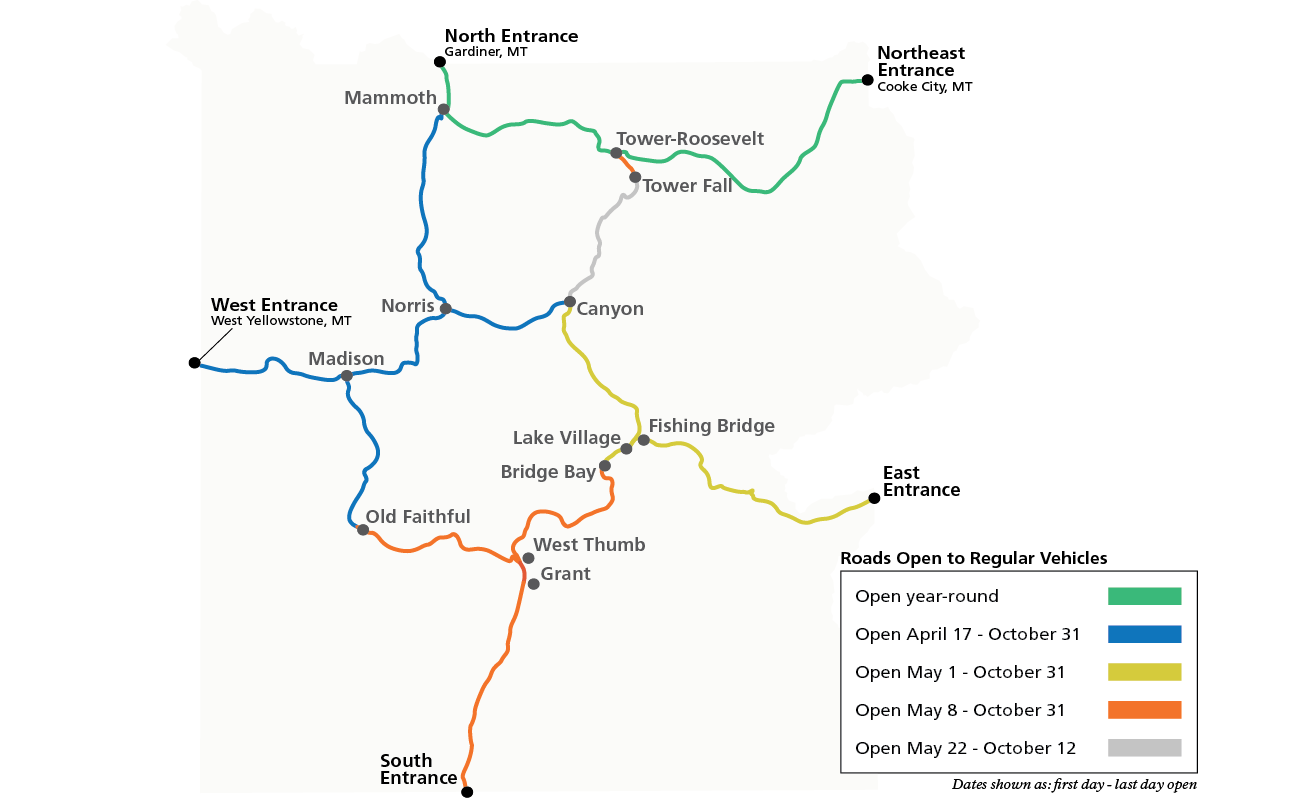
Yellowstone’s road page, updated October 28, 2026, is a more consequential planning document than the fee calendar for a November drive. Its projected schedule lists October 31 as the end of regular-vehicle access on many major segments, including routes from the west, east and south entrances. The road generally open year-round to ordinary vehicles runs from the North Entrance at Gardiner through the park toward Cooke City via Tower Junction. That is not the same as a fully open loop through Yellowstone.
These are projected dates, explicitly subject to weather and other conditions, not a guarantee that any road will remain open until a listed hour. Likewise, “North Entrance to Northeast Entrance” does not mean every approach beyond the park is available. NPS separately describes winter restrictions and seasonal closure on connecting roads outside the Northeast Entrance. Plan the entire route to and from the park, not just the line within the boundary.
The map below is an official seasonal planning map, not live navigation. Its distinct colored routes make the limitation visible: a visitor cannot treat an entrance station, a favorite attraction and an overnight stop as connected merely because they sit in the same park. Check the live road status immediately before travel and again if conditions change. If the purpose of the trip requires a closed route, a fee waiver is not a reason to improvise an alternative across unfamiliar winter roads.

A summer shuttle photograph is not a November service promise
Rocky Mountain National Park provides an equally useful lesson about transport. Its 2026 shuttle schedule lists May 22 through October 18 for the Bear Lake and Moraine Park routes. The Hiker Shuttle’s late-season weekend service also ended October 18. A photograph of a bus at a popular trailhead—or a description of the free summer shuttle—does not establish a ride on Veterans Day.
This changes the planning problem for people who do not drive, or who rely on a vehicle with a ramp to complete the final leg of a trip. Check the season first, then whether the route reaches the desired stop, then the boarding and trailhead conditions. A bus can be wheelchair accessible while the path beyond its stop presents barriers. NPS specifically tells visitors to discuss assistance and destinations with shuttle staff; a summer transport provision should not be carried forward into a winter itinerary.

Camping is another reservation—and another bill
The park’s 2026–27 winter camping section names Moraine Park as its only open campground for the winter season beginning October 19. It describes first-come, first-served availability, with standard non-electric sites at $30 per night and standard electric sites at $55. An entrance-fee waiver does not turn those overnight stays into free camping, and first-come availability does not guarantee a suitable campsite will remain when a party arrives.
Read the specific site’s facilities, not just the campground name. Rocky Mountain’s accessibility information describes improved Moraine Park sites with paved routes, extended picnic tables and raised fire rings. That is more useful than a generic accessible symbol for judging how a campsite may work. Winter introduces another condition: NPS says individual sites are not shoveled or plowed by staff. A paved surface in an archive photo does not establish a clear route after snowfall.
The camping page also distinguishes discounts: Access and Senior Pass holders receive a 50 percent discount on standard sites, while a Military Pass does not itself provide a camping discount. Eligibility for more than one pass therefore deserves a careful comparison, not an assumption that the military option is always the broadest. Verify the applicable charge and facilities with the campground before committing to an overnight stay, especially when a water, power or restroom requirement is essential rather than optional.

An Access Pass waives a fee, not a physical barrier
The Access Pass is available without a pass purchase price to U.S. citizens or residents with a medically determined permanent disability that severely limits one or more major life activities. NPS says it need not be a 100 percent disability. The program requires identification and qualifying documentation, with several forms described on the official page. It is distinct from simply needing an easier walk on a particular day, and distinct from a guarantee that every facility is accessible.
Sprague Lake shows why a visitor should read a route description in addition to a pass description. Rocky Mountain’s mobility guide lists a roughly 0.8-mile trail, an average width of 65 inches and a minimum width of 40 inches. It also identifies transitions to bridges and boardwalks, puddles after rain, and snow or ice as possible barriers. Its accessible backcountry campsite is listed for May through October, not as a year-round Veterans Day booking option.
A photograph can help someone understand the surface and setting; the measurements help them judge the route against their own equipment and needs. Neither replaces a current condition report. Ask concrete questions about the approach from parking, the narrowest segment, the return distance and the restroom—not merely whether the park is “accessible.” The aim is to identify a workable visit, including a shorter alternative, without making the traveler discover a crucial gap after arriving.

“Easy” and “open” need more detail
At Petrified Forest in Arizona, Giant Logs Trail is described as an easy, 0.4-mile loop behind Rainbow Forest Museum, with a typical visit of at least half an hour. The same official listing provides a maximum grade of 19.1 percent and a minimum tread width of 48 inches. That is why a broad difficulty label is not enough for every visitor. A short route can still contain a steep portion; someone planning with a mobility device needs the numbers and present surface conditions.
The trail’s numbered stops correspond to a self-guiding booklet from the museum. That creates a practical sequence: confirm the museum’s hours, get the material before starting, and leave enough time for reading and returning rather than treating the distance as a speed target. The preserved wood is a protected resource, not a souvenir. A visit that allows time to look closely can be more satisfying than trying to add another stop before the gate closes.

The park’s published operating-hours page lists 8 a.m. to 5 p.m. for the park road and the main visitor centers, and 9 a.m. to 4 p.m. for Painted Desert Inn. It says the park is open year-round except Thanksgiving and Christmas. Those are published operating hours, not confirmation that no alert or temporary restriction will affect November 11. Check the current park notice before relying on them.
Petrified Forest uses Mountain Standard Time year-round. For travelers arriving from a place that changes clocks, the local time—not a remembered summer time difference—must govern the route. Our separate guide to the November 1 clock change explains why device settings and appointment times should be checked separately. Here, that means planning a return to the exit before closing, not assuming late-afternoon light is permission to stay.

Reporting and image notes
NEWJINMEDIA · October 29, 2026. Independently prepared from National Park Service program rules and park-level visitor information available October 28, U.S. time. No on-site reporting or interviews are claimed. Linked park pages are the primary sources for the dates, fees and facilities described. Photographs are NPS archive material, not documentation of November 11 conditions; the Yellowstone map is the park’s projected 2026 road calendar. No claim to original U.S. Government works.


Comments
Post a Comment