Wesnoth: plan for
the enemy turn

Wesnoth rewards armies that survive bad rolls. Read terrain, retreat routes and campaign costs before committing your next attack.
A wounded enemy stands one blow from defeat. Your veteran can reach it, the attack preview looks encouraging, and the next level is close. The tempting question is whether the veteran can finish the job. The more useful question is where that veteran will stand when the opponent moves. In The Battle for Wesnoth, a successful attack can still leave a valuable unit in a losing position. The battlefield does not reset after the satisfying animation.
That is the central tension of this free, open-source, turn-based fantasy strategy game. A campaign links battles through surviving units, experience and gold. The army that wins one scenario becomes the starting point for another, so a victory has a quality as well as a result. This guide examines the established rules documented in the official 1.18 manual and uses the project's own screenshot archive to illustrate the interface and terrain. It is an analysis of those systems, not a claim of a newly released update or a hands-on benchmark.
Choose a campaign you can learn from
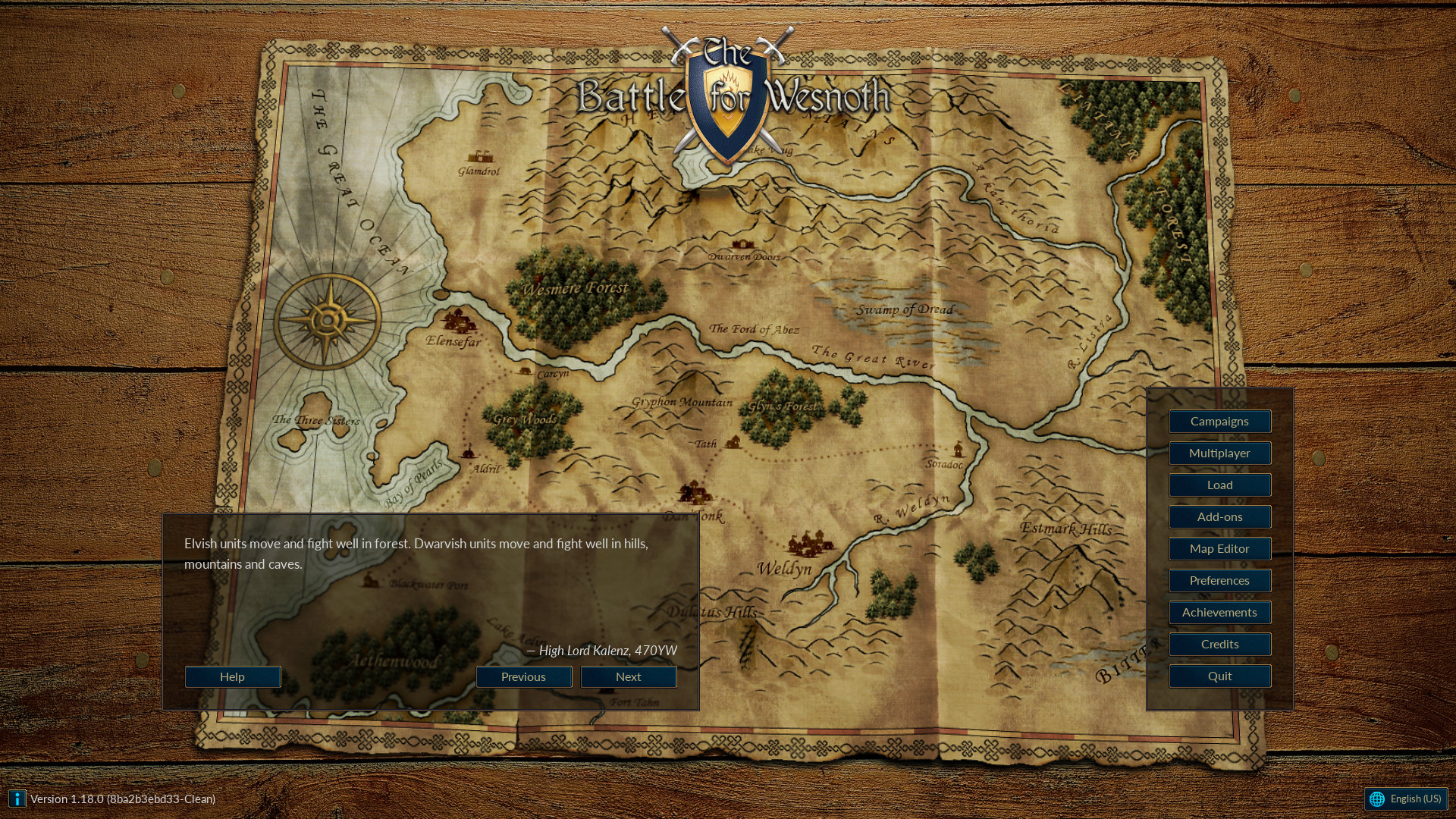
The official campaign menu separates stories rather than offering one universal progression ladder. Read its difficulty, length and description before choosing. A short introductory campaign gives a new player a smaller set of units and situations to understand. A longer story asks the player to maintain a roster across more maps, with more chances for an early loss to matter later. The tutorial is useful even for someone familiar with other hex-based games because familiar-looking icons do not guarantee familiar rules.
Before recruiting, open the scenario objectives. Killing the opposing leader is a common goal, but reaching a location, escorting a character or surviving a set number of turns can change which fights are worth taking. A compulsory character's death may end the scenario even if the rest of the army is healthy. The best-looking combat exchange can therefore be irrelevant to the actual win condition. Identify the required survivors and the turn limit first; treat everything else as a means of meeting those conditions.
Difficulty also changes the meaning of an experiment. Learning how a unit moves through water is inexpensive in a small practice encounter and expensive when the mistake consumes a veteran late in a campaign. A sensible first session can be deliberately modest: finish the tutorial, start a short campaign and learn to read one faction's movement and attack information. There is no need to understand every creature in the unit encyclopedia before making useful decisions.

Read the hex from both sides
Wesnoth separates movement, defense and resistance. Movement determines where a unit can go. Defense generally determines the chance that an ordinary incoming strike misses on the occupied terrain. Resistance changes the damage from a particular damage type when a strike lands. A forest is not a universal armor bonus, and a mountain is not equally accessible to every unit. Select the actual unit and inspect the hex rather than transferring assumptions from another army.
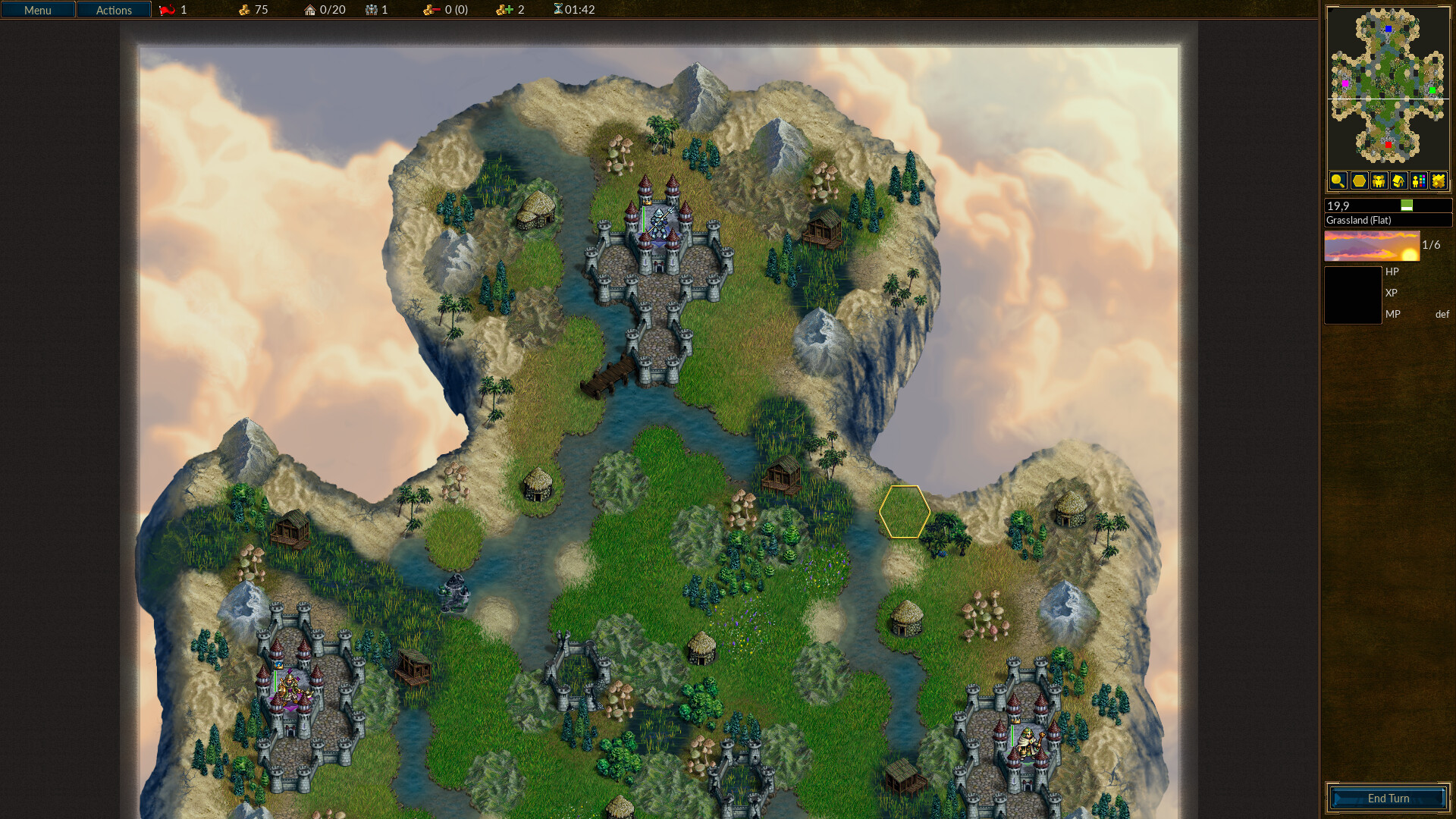
The difference matters at a river crossing. A unit that reaches the opposite bank may have spent nearly all of its movement and left support behind. Another may stand in shallow water, where its defensive performance differs from that of a unit adapted to aquatic terrain. A bridge can provide a convenient route while also concentrating traffic into a narrow approach. The map is simultaneously a movement network, a set of defensive positions and a limit on how many units can engage one target.
Compare the positions on both sides of a proposed attack. If you strike an enemy occupying a village from open ground, the defender may have both favorable terrain and an easier place to recover. The attack preview can explain that exchange; it does not automatically price in every enemy that can reach your exposed attacker afterward. A useful habit is to inspect the enemy's possible moves before committing the final friendly unit. The safe square is the one that remains defensible after the opposing side acts, not simply the square you can reach now.

A percentage is a distribution, not a promise
A weapon's damage display combines damage per successful strike with the number of strikes. For an illustrative attack dealing 6 damage across four strikes at a 60% hit chance, the maximum is 24 damage and the expected damage is 14.4. Neither figure says that the attack will deliver 14 damage. The possible outcomes arrive in six-point increments, assuming no other effects interrupt the exchange. A defender with 12 hit points requires at least two successful strikes in this simplified example.
With independent 60% hit rolls, the chance of fewer than two hits is 17.92%: 2.56% for no hits, plus 15.36% for exactly one. That leaves an 82.08% chance of reaching at least 12 damage if all four strikes occur. Real combat can differ because retaliation may kill the attacker before every strike, and abilities or specials can alter the calculation. Use the game's damage-calculation display for the actual matchup rather than substituting this example for the engine's result.
The practical point is the surviving branch of the decision tree. What happens if the target lives? Can another unit finish it without blocking a retreat? Does the failed attack leave a gap in the line? If a plan works only when every favorable roll arrives, it is fragile even when each individual attack looks reasonable. A reserve is not wasted damage. It is an option that remains available after the first result becomes known. Commit additional attackers in response to the result instead of spending every movement point on a single predicted outcome.

Build a line with a way out
Most units project a zone of control into the six neighboring hexes. Entering an enemy zone of control normally stops movement. Level-zero units do not project that control, and the skirmisher ability can bypass it. Those exceptions make unit identity crucial: a line that obstructs ordinary infantry may not obstruct every opponent. The movement preview already accounts for the restrictions, so check the proposed route instead of counting the straight-line distance by eye.
A tight formation can protect a vulnerable healer, but it can also trap your own wounded unit. Before moving the last reserve forward, leave a reachable hex where an injured front-line unit can withdraw. Think about the sequence: the replacement may need to move out of the way first, or a rear unit may need to clear a path before the veteran can retreat. Filling every attractive defensive hex can make the line look strong while making rotation impossible.
A narrow front has another advantage: it reduces the number of enemies that can attack a single unit. That does not make a choke point invulnerable. Ranged weapons, unfavorable terrain, specials and the approaching time-of-day change still matter. It does make exposure easier to estimate. Count reachable attackers, not just nearby icons. A fast enemy farther away may be a greater threat than a slow one beside a terrain obstacle, particularly if it can reach a rear unit that was protected only by distance.

The clock changes the value of waiting
The standard six-turn day moves through dawn, two daylight phases, dusk and two night phases. Lawful units receive a daytime damage bonus and a nighttime penalty; chaotic units follow the reverse pattern. The manual gives those ordinary modifiers as 25%. Neutral units are unaffected by the normal cycle, while liminal units have a different relationship to daylight, night and twilight. Underground conditions and illumination can complicate the simple outdoor pattern, so the indicator on the actual scenario takes precedence.
Suppose your lawful units are about to enter a battle in the second daylight phase. The immediate attack may benefit from daylight, but its aftermath arrives as that advantage fades. Pushing one more hex can leave the army committed when the enemy's preferred period begins. By contrast, advancing under cover and attacking as favorable conditions start can create a longer window in which to exploit a breakthrough. Timing is not just a bonus attached to a single swing; it shapes how long you can sustain pressure.
Waiting also costs something. A scenario deadline, a threatened ally or an opponent collecting village income may make a purely defensive pause too expensive. The decision is therefore not 'always attack at the right hour.' It is whether the benefit of waiting exceeds the loss of time, position and income. Read the cycle alongside the objectives. An army that preserves every hit point but runs out of turns has not solved the scenario's problem.

Match the weapon, not the portrait
Melee and ranged combat in Wesnoth describe the type of exchange, not an unlimited ability to shoot across the map. An ordinary attack is made against an adjacent enemy. The defender retaliates with the corresponding weapon category if it has one. A unit without a ranged weapon cannot retaliate in that category during the same exchange, but it may still attack on its own turn. Avoiding immediate retaliation is useful; it is not immunity from the next phase of combat.
Damage type is a separate question. Blade, pierce, impact, fire, cold and arcane attacks interact with the target's resistances. A visually imposing sword is not necessarily the efficient answer to the enemy in front of it. Check the unit information rather than treating faction artwork as a complete guide. Specials such as magical attacks or marksman can also change the relevance of terrain defense. The attack dialog is a compact explanation of the current matchup, not merely a confirmation button.
This is why a varied roster can outperform a uniform group of stronger-looking units. A specialist may solve one difficult encounter without being the best unit to occupy the front line afterward. Positioning the specialist requires another unit to hold space, absorb exposure or finish a different target. The useful comparison is the combined result of the group. Spending the best defender on an easy kill can leave the specialist unable to advance safely, even though the first exchange was efficient on its own.

Healing is a route-planning problem
Villages provide a place to recover as well as an economic objective. Under the documented standard rules, a village heals eight hit points per turn. Units with healing abilities can support adjacent allies, and resting can add two hit points when a unit neither moves nor fights. Multiple ordinary healing sources do not simply stack into unlimited recovery. A unit with regeneration likewise does not gain an extra full dose merely by standing beside a healer.
The distance to recovery is often more important than the nominal healing rate. A wounded unit that cannot reach safety may not survive to receive the benefit. A village on the wrong side of an enemy zone of control is not an available hospital. Reserve a retreat route before the unit is in immediate danger, and keep enough healthy troops between the recovery area and enemy movement. Sending a healer forward to rescue one unit can expose several others if the healer is then lost.
Poison makes the distinction between stabilizing and curing important. An ability that prevents poison damage for a turn does not necessarily remove the condition. Read the healer's description and the status icon. Similarly, a unit's eventual level-up may restore it, but that is a conditional future event, not current protection. Treat a guaranteed place to recover and a hoped-for finishing blow as different resources. The former can support a repeatable rotation; the latter is another bet on the next exchange.

A veteran has costs beyond its purchase price
In a campaign, surviving troops can become available to recall in later scenarios. The standard recall cost documented in the manual is 20 gold, although scenario rules can vary. A recalled unit retains experience and returns with full hit points. That creates a long-term reason to protect useful units, but it does not mean recalling every veteran is economical. Upkeep is generally related to unit level, with exceptions such as loyal units, so a force full of advanced troops can burden the budget.
Read the income display and scenario-specific carryover information rather than assuming that a village or a quick finish has an identical value in every campaign. The useful question is how much army is needed to achieve this map's goal while preserving options for the next one. Recruiting too much ties resources to units that may spend the battle marching. Recruiting too little can turn a manageable defense into a desperate series of attacks with no reserve.
Experience allocation is another investment decision. Letting a developing unit finish an enemy can help build a replacement for an aging core of specialists. But arranging the perfect finishing blow can be dangerous if it requires leaving the target alive or moving a fragile recruit into several enemies' reach. The campaign reward does not erase the tactical risk. A balanced roster grows through survivable opportunities, not through an obligation to award every kill to the unit closest to advancement.

Learn from the decision before the result
A replay or a return to an earlier save is most useful when it answers a specific question. Did the attack fail because a low-probability outcome occurred, or because the plan had no room for that outcome? Did a unit die because its terrain was poor, because too many enemies could reach it, or because the retreat path had already been filled? These are different mistakes and call for different changes. Repeating the same sequence until the rolls improve can hide the positioning problem.
A simple review method is to pause at the turn before a major loss. Identify which information was visible then: terrain, remaining movement, enemy reach, alignment, hit points and the objective. Decide whether a different placement would have reduced exposure without making victory impossible. That is a fairer test of the decision than judging it only after seeing all the rolls. A sound plan can have a bad outcome; a careless plan can occasionally be rewarded.
Multiplayer adds another source of uncertainty because a human opponent can choose a different response from the one you anticipated. A lobby, match history or achievement screen records participation and results, but it does not explain the quality of a position. Start with a small local game or a suitable beginner setting if the interface itself still demands attention. Learning to inspect a unit's attack options calmly is more useful than measuring progress only by wins, completion badges or the number of campaigns installed.
Use the editor to ask a smaller question
Wesnoth's map and scenario tools expose how much of a battle is created by the arrangement of terrain. Changing the width of a crossing, the spacing of villages or the distance between castles changes where an army can concentrate and how quickly it can replace losses. A visually attractive map is not automatically balanced. The important distances are measured in the movement costs of the units that will use it, not simply in the number of hexes between landmarks.
For a player learning the game, this suggests a useful mental exercise even without publishing anything: imagine moving one village or widening one approach. Which side gains a safer recovery point? Which units gain a route that was previously too slow? The exercise separates the map's decorative appearance from its functional layout. The editor screenshot included here also shows that creating a map and preparing an add-on for distribution are separate steps; a finished-looking landscape is not by itself a complete campaign.
The strongest habit to carry back into ordinary play is a short end-of-turn audit. Confirm the objective, check the next time-of-day phase, inspect enemy reach, keep a recovery route and ask what happens if the first attack fails. None of these checks removes chance. Together they reduce the number of outcomes that turn one unlucky exchange into a collapsed army. Wesnoth becomes more readable when the next kill is treated as one event inside a longer sequence, and the enemy turn is planned for before it begins.

Screenshot permissions and complete GNU Free Documentation License
                GNU Free Documentation License
                 Version 1.3, 3 November 2008


 Copyright (C) 2000, 2001, 2002, 2007, 2008 Free Software Foundation, Inc.
     <https://fsf.org/>
 Everyone is permitted to copy and distribute verbatim copies
 of this license document, but changing it is not allowed.

0. PREAMBLE

The purpose of this License is to make a manual, textbook, or other
functional and useful document "free" in the sense of freedom: to
assure everyone the effective freedom to copy and redistribute it,
with or without modifying it, either commercially or noncommercially.
Secondarily, this License preserves for the author and publisher a way
to get credit for their work, while not being considered responsible
for modifications made by others.

This License is a kind of "copyleft", which means that derivative
works of the document must themselves be free in the same sense.  It
complements the GNU General Public License, which is a copyleft
license designed for free software.

We have designed this License in order to use it for manuals for free
software, because free software needs free documentation: a free
program should come with manuals providing the same freedoms that the
software does.  But this License is not limited to software manuals;
it can be used for any textual work, regardless of subject matter or
whether it is published as a printed book.  We recommend this License
principally for works whose purpose is instruction or reference.


1. APPLICABILITY AND DEFINITIONS

This License applies to any manual or other work, in any medium, that
contains a notice placed by the copyright holder saying it can be
distributed under the terms of this License.  Such a notice grants a
world-wide, royalty-free license, unlimited in duration, to use that
work under the conditions stated herein.  The "Document", below,
refers to any such manual or work.  Any member of the public is a
licensee, and is addressed as "you".  You accept the license if you
copy, modify or distribute the work in a way requiring permission
under copyright law.

A "Modified Version" of the Document means any work containing the
Document or a portion of it, either copied verbatim, or with
modifications and/or translated into another language.

A "Secondary Section" is a named appendix or a front-matter section of
the Document that deals exclusively with the relationship of the
publishers or authors of the Document to the Document's overall
subject (or to related matters) and contains nothing that could fall
directly within that overall subject.  (Thus, if the Document is in
part a textbook of mathematics, a Secondary Section may not explain
any mathematics.)  The relationship could be a matter of historical
connection with the subject or with related matters, or of legal,
commercial, philosophical, ethical or political position regarding
them.

The "Invariant Sections" are certain Secondary Sections whose titles
are designated, as being those of Invariant Sections, in the notice
that says that the Document is released under this License.  If a
section does not fit the above definition of Secondary then it is not
allowed to be designated as Invariant.  The Document may contain zero
Invariant Sections.  If the Document does not identify any Invariant
Sections then there are none.

The "Cover Texts" are certain short passages of text that are listed,
as Front-Cover Texts or Back-Cover Texts, in the notice that says that
the Document is released under this License.  A Front-Cover Text may
be at most 5 words, and a Back-Cover Text may be at most 25 words.

A "Transparent" copy of the Document means a machine-readable copy,
represented in a format whose specification is available to the
general public, that is suitable for revising the document
straightforwardly with generic text editors or (for images composed of
pixels) generic paint programs or (for drawings) some widely available
drawing editor, and that is suitable for input to text formatters or
for automatic translation to a variety of formats suitable for input
to text formatters.  A copy made in an otherwise Transparent file
format whose markup, or absence of markup, has been arranged to thwart
or discourage subsequent modification by readers is not Transparent.
An image format is not Transparent if used for any substantial amount
of text.  A copy that is not "Transparent" is called "Opaque".

Examples of suitable formats for Transparent copies include plain
ASCII without markup, Texinfo input format, LaTeX input format, SGML
or XML using a publicly available DTD, and standard-conforming simple
HTML, PostScript or PDF designed for human modification.  Examples of
transparent image formats include PNG, XCF and JPG.  Opaque formats
include proprietary formats that can be read and edited only by
proprietary word processors, SGML or XML for which the DTD and/or
processing tools are not generally available, and the
machine-generated HTML, PostScript or PDF produced by some word
processors for output purposes only.

The "Title Page" means, for a printed book, the title page itself,
plus such following pages as are needed to hold, legibly, the material
this License requires to appear in the title page.  For works in
formats which do not have any title page as such, "Title Page" means
the text near the most prominent appearance of the work's title,
preceding the beginning of the body of the text.

The "publisher" means any person or entity that distributes copies of
the Document to the public.

A section "Entitled XYZ" means a named subunit of the Document whose
title either is precisely XYZ or contains XYZ in parentheses following
text that translates XYZ in another language.  (Here XYZ stands for a
specific section name mentioned below, such as "Acknowledgements",
"Dedications", "Endorsements", or "History".)  To "Preserve the Title"
of such a section when you modify the Document means that it remains a
section "Entitled XYZ" according to this definition.

The Document may include Warranty Disclaimers next to the notice which
states that this License applies to the Document.  These Warranty
Disclaimers are considered to be included by reference in this
License, but only as regards disclaiming warranties: any other
implication that these Warranty Disclaimers may have is void and has
no effect on the meaning of this License.

2. VERBATIM COPYING

You may copy and distribute the Document in any medium, either
commercially or noncommercially, provided that this License, the
copyright notices, and the license notice saying this License applies
to the Document are reproduced in all copies, and that you add no
other conditions whatsoever to those of this License.  You may not use
technical measures to obstruct or control the reading or further
copying of the copies you make or distribute.  However, you may accept
compensation in exchange for copies.  If you distribute a large enough
number of copies you must also follow the conditions in section 3.

You may also lend copies, under the same conditions stated above, and
you may publicly display copies.


3. COPYING IN QUANTITY

If you publish printed copies (or copies in media that commonly have
printed covers) of the Document, numbering more than 100, and the
Document's license notice requires Cover Texts, you must enclose the
copies in covers that carry, clearly and legibly, all these Cover
Texts: Front-Cover Texts on the front cover, and Back-Cover Texts on
the back cover.  Both covers must also clearly and legibly identify
you as the publisher of these copies.  The front cover must present
the full title with all words of the title equally prominent and
visible.  You may add other material on the covers in addition.
Copying with changes limited to the covers, as long as they preserve
the title of the Document and satisfy these conditions, can be treated
as verbatim copying in other respects.

If the required texts for either cover are too voluminous to fit
legibly, you should put the first ones listed (as many as fit
reasonably) on the actual cover, and continue the rest onto adjacent
pages.

If you publish or distribute Opaque copies of the Document numbering
more than 100, you must either include a machine-readable Transparent
copy along with each Opaque copy, or state in or with each Opaque copy
a computer-network location from which the general network-using
public has access to download using public-standard network protocols
a complete Transparent copy of the Document, free of added material.
If you use the latter option, you must take reasonably prudent steps,
when you begin distribution of Opaque copies in quantity, to ensure
that this Transparent copy will remain thus accessible at the stated
location until at least one year after the last time you distribute an
Opaque copy (directly or through your agents or retailers) of that
edition to the public.

It is requested, but not required, that you contact the authors of the
Document well before redistributing any large number of copies, to
give them a chance to provide you with an updated version of the
Document.


4. MODIFICATIONS

You may copy and distribute a Modified Version of the Document under
the conditions of sections 2 and 3 above, provided that you release
the Modified Version under precisely this License, with the Modified
Version filling the role of the Document, thus licensing distribution
and modification of the Modified Version to whoever possesses a copy
of it.  In addition, you must do these things in the Modified Version:

A. Use in the Title Page (and on the covers, if any) a title distinct
   from that of the Document, and from those of previous versions
   (which should, if there were any, be listed in the History section
   of the Document).  You may use the same title as a previous version
   if the original publisher of that version gives permission.
B. List on the Title Page, as authors, one or more persons or entities
   responsible for authorship of the modifications in the Modified
   Version, together with at least five of the principal authors of the
   Document (all of its principal authors, if it has fewer than five),
   unless they release you from this requirement.
C. State on the Title page the name of the publisher of the
   Modified Version, as the publisher.
D. Preserve all the copyright notices of the Document.
E. Add an appropriate copyright notice for your modifications
   adjacent to the other copyright notices.
F. Include, immediately after the copyright notices, a license notice
   giving the public permission to use the Modified Version under the
   terms of this License, in the form shown in the Addendum below.
G. Preserve in that license notice the full lists of Invariant Sections
   and required Cover Texts given in the Document's license notice.
H. Include an unaltered copy of this License.
I. Preserve the section Entitled "History", Preserve its Title, and add
   to it an item stating at least the title, year, new authors, and
   publisher of the Modified Version as given on the Title Page.  If
   there is no section Entitled "History" in the Document, create one
   stating the title, year, authors, and publisher of the Document as
   given on its Title Page, then add an item describing the Modified
   Version as stated in the previous sentence.
J. Preserve the network location, if any, given in the Document for
   public access to a Transparent copy of the Document, and likewise
   the network locations given in the Document for previous versions
   it was based on.  These may be placed in the "History" section.
   You may omit a network location for a work that was published at
   least four years before the Document itself, or if the original
   publisher of the version it refers to gives permission.
K. For any section Entitled "Acknowledgements" or "Dedications",
   Preserve the Title of the section, and preserve in the section all
   the substance and tone of each of the contributor acknowledgements
   and/or dedications given therein.
L. Preserve all the Invariant Sections of the Document,
   unaltered in their text and in their titles.  Section numbers
   or the equivalent are not considered part of the section titles.
M. Delete any section Entitled "Endorsements".  Such a section
   may not be included in the Modified Version.
N. Do not retitle any existing section to be Entitled "Endorsements"
   or to conflict in title with any Invariant Section.
O. Preserve any Warranty Disclaimers.

If the Modified Version includes new front-matter sections or
appendices that qualify as Secondary Sections and contain no material
copied from the Document, you may at your option designate some or all
of these sections as invariant.  To do this, add their titles to the
list of Invariant Sections in the Modified Version's license notice.
These titles must be distinct from any other section titles.

You may add a section Entitled "Endorsements", provided it contains
nothing but endorsements of your Modified Version by various
parties--for example, statements of peer review or that the text has
been approved by an organization as the authoritative definition of a
standard.

You may add a passage of up to five words as a Front-Cover Text, and a
passage of up to 25 words as a Back-Cover Text, to the end of the list
of Cover Texts in the Modified Version.  Only one passage of
Front-Cover Text and one of Back-Cover Text may be added by (or
through arrangements made by) any one entity.  If the Document already
includes a cover text for the same cover, previously added by you or
by arrangement made by the same entity you are acting on behalf of,
you may not add another; but you may replace the old one, on explicit
permission from the previous publisher that added the old one.

The author(s) and publisher(s) of the Document do not by this License
give permission to use their names for publicity for or to assert or
imply endorsement of any Modified Version.


5. COMBINING DOCUMENTS

You may combine the Document with other documents released under this
License, under the terms defined in section 4 above for modified
versions, provided that you include in the combination all of the
Invariant Sections of all of the original documents, unmodified, and
list them all as Invariant Sections of your combined work in its
license notice, and that you preserve all their Warranty Disclaimers.

The combined work need only contain one copy of this License, and
multiple identical Invariant Sections may be replaced with a single
copy.  If there are multiple Invariant Sections with the same name but
different contents, make the title of each such section unique by
adding at the end of it, in parentheses, the name of the original
author or publisher of that section if known, or else a unique number.
Make the same adjustment to the section titles in the list of
Invariant Sections in the license notice of the combined work.

In the combination, you must combine any sections Entitled "History"
in the various original documents, forming one section Entitled
"History"; likewise combine any sections Entitled "Acknowledgements",
and any sections Entitled "Dedications".  You must delete all sections
Entitled "Endorsements".


6. COLLECTIONS OF DOCUMENTS

You may make a collection consisting of the Document and other
documents released under this License, and replace the individual
copies of this License in the various documents with a single copy
that is included in the collection, provided that you follow the rules
of this License for verbatim copying of each of the documents in all
other respects.

You may extract a single document from such a collection, and
distribute it individually under this License, provided you insert a
copy of this License into the extracted document, and follow this
License in all other respects regarding verbatim copying of that
document.


7. AGGREGATION WITH INDEPENDENT WORKS

A compilation of the Document or its derivatives with other separate
and independent documents or works, in or on a volume of a storage or
distribution medium, is called an "aggregate" if the copyright
resulting from the compilation is not used to limit the legal rights
of the compilation's users beyond what the individual works permit.
When the Document is included in an aggregate, this License does not
apply to the other works in the aggregate which are not themselves
derivative works of the Document.

If the Cover Text requirement of section 3 is applicable to these
copies of the Document, then if the Document is less than one half of
the entire aggregate, the Document's Cover Texts may be placed on
covers that bracket the Document within the aggregate, or the
electronic equivalent of covers if the Document is in electronic form.
Otherwise they must appear on printed covers that bracket the whole
aggregate.


8. TRANSLATION

Translation is considered a kind of modification, so you may
distribute translations of the Document under the terms of section 4.
Replacing Invariant Sections with translations requires special
permission from their copyright holders, but you may include
translations of some or all Invariant Sections in addition to the
original versions of these Invariant Sections.  You may include a
translation of this License, and all the license notices in the
Document, and any Warranty Disclaimers, provided that you also include
the original English version of this License and the original versions
of those notices and disclaimers.  In case of a disagreement between
the translation and the original version of this License or a notice
or disclaimer, the original version will prevail.

If a section in the Document is Entitled "Acknowledgements",
"Dedications", or "History", the requirement (section 4) to Preserve
its Title (section 1) will typically require changing the actual
title.


9. TERMINATION

You may not copy, modify, sublicense, or distribute the Document
except as expressly provided under this License.  Any attempt
otherwise to copy, modify, sublicense, or distribute it is void, and
will automatically terminate your rights under this License.

However, if you cease all violation of this License, then your license
from a particular copyright holder is reinstated (a) provisionally,
unless and until the copyright holder explicitly and finally
terminates your license, and (b) permanently, if the copyright holder
fails to notify you of the violation by some reasonable means prior to
60 days after the cessation.

Moreover, your license from a particular copyright holder is
reinstated permanently if the copyright holder notifies you of the
violation by some reasonable means, this is the first time you have
received notice of violation of this License (for any work) from that
copyright holder, and you cure the violation prior to 30 days after
your receipt of the notice.

Termination of your rights under this section does not terminate the
licenses of parties who have received copies or rights from you under
this License.  If your rights have been terminated and not permanently
reinstated, receipt of a copy of some or all of the same material does
not give you any rights to use it.


10. FUTURE REVISIONS OF THIS LICENSE

The Free Software Foundation may publish new, revised versions of the
GNU Free Documentation License from time to time.  Such new versions
will be similar in spirit to the present version, but may differ in
detail to address new problems or concerns.  See
https://www.gnu.org/licenses/.

Each version of the License is given a distinguishing version number.
If the Document specifies that a particular numbered version of this
License "or any later version" applies to it, you have the option of
following the terms and conditions either of that specified version or
of any later version that has been published (not as a draft) by the
Free Software Foundation.  If the Document does not specify a version
number of this License, you may choose any version ever published (not
as a draft) by the Free Software Foundation.  If the Document
specifies that a proxy can decide which future versions of this
License can be used, that proxy's public statement of acceptance of a
version permanently authorizes you to choose that version for the
Document.

11. RELICENSING

"Massive Multiauthor Collaboration Site" (or "MMC Site") means any
World Wide Web server that publishes copyrightable works and also
provides prominent facilities for anybody to edit those works.  A
public wiki that anybody can edit is an example of such a server.  A
"Massive Multiauthor Collaboration" (or "MMC") contained in the site
means any set of copyrightable works thus published on the MMC site.

"CC-BY-SA" means the Creative Commons Attribution-Share Alike 3.0
license published by Creative Commons Corporation, a not-for-profit
corporation with a principal place of business in San Francisco,
California, as well as future copyleft versions of that license
published by that same organization.

"Incorporate" means to publish or republish a Document, in whole or in
part, as part of another Document.

An MMC is "eligible for relicensing" if it is licensed under this
License, and if all works that were first published under this License
somewhere other than this MMC, and subsequently incorporated in whole or
in part into the MMC, (1) had no cover texts or invariant sections, and
(2) were thus incorporated prior to November 1, 2008.

The operator of an MMC Site may republish an MMC contained in the site
under CC-BY-SA on the same site at any time before August 1, 2009,
provided the MMC is eligible for relicensing.


ADDENDUM: How to use this License for your documents

To use this License in a document you have written, include a copy of
the License in the document and put the following copyright and
license notices just after the title page:

    Copyright (c)  YEAR  YOUR NAME.
    Permission is granted to copy, distribute and/or modify this document
    under the terms of the GNU Free Documentation License, Version 1.3
    or any later version published by the Free Software Foundation;
    with no Invariant Sections, no Front-Cover Texts, and no Back-Cover Texts.
    A copy of the license is included in the section entitled "GNU
    Free Documentation License".

If you have Invariant Sections, Front-Cover Texts and Back-Cover Texts,
replace the "with...Texts." line with this:

    with the Invariant Sections being LIST THEIR TITLES, with the
    Front-Cover Texts being LIST, and with the Back-Cover Texts being LIST.

If you have Invariant Sections without Cover Texts, or some other
combination of the three, merge those two alternatives to suit the
situation.

If your document contains nontrivial examples of program code, we
recommend releasing these examples in parallel under your choice of
free software license, such as the GNU General Public License,
to permit their use in free software.




Comments
Post a Comment