NPS bicycle & e-bike proposal

NPS proposes changes to bicycle and e-bike route approvals. After the November 2 comment deadline, existing park restrictions still apply.
The decision is about the route into a decision
A cyclist approaching a stone carriage-road bridge at Acadia sees a continuous riding surface. A park manager sees several separate questions: who is allowed to use that surface, which bicycle classes qualify, whether a designation needs a national rulemaking, and what environmental analysis accompanies the decision. A federal proposal published on September 1 would rearrange that administrative sequence across the National Park System.
The notice, “Bicycle Use in Park Areas,” set November 2, 2026, at 11:59 p.m. Eastern Time as its comment deadline. That date marks the end of the notice’s stated comment window, not the beginning of new riding rights. The document reviewed for this report is a proposed rule, not a final rule with an effective date. Its wording therefore matters in the conditional: what the agency would permit its managers to do, and which procedures it would retain or remove.
Three layers that should not be collapsed
The clearest change concerns public motor-vehicle roads
The proposed replacement for section 4.30 would allow traditional bicycles and e-bikes on park roads and in parking areas otherwise open to motor vehicles used by the general public. NPS says this would not change the baseline for traditional bicycles. For e-bikes, it would remove the current need for an affirmative superintendent designation in those locations.
That is an administrative change with a defined boundary. It does not describe every service road or every track visible on a map. The notice distinguishes administrative roads, used by NPS for its own operations but not open to public motor traffic, from ordinary public roads. Those administrative roads would remain in the separate category requiring a designation for bicycle use.
Nor does “allowed on a road” mean “provided with a bicycle lane.” Acadia’s current visitor guidance warns that the Park Loop Road has no shoulder. The accompanying NPS photograph shows a cyclist between parked vehicles and moving traffic. Blue Ridge Parkway similarly cautions that it has no designated bicycle lanes. The legal permission and the physical margin for safely passing are different pieces of information.

A trail’s history could decide which procedure applies
For other locations, the proposal would give superintendents designation authority after public notice through the methods specified in section 1.7. It would retain Federal Register rulemaking in two circumstances. One concerns designations meeting the significance or controversy criteria in section 1.5(b). The other concerns locations that have never been improved with artificial or processed materials.
The proposed text gives examples of those materials: gravel, asphalt, concrete, steel rail lines, wood boards, soil cement, and resin-based material. The historical element is important. A route with a natural-looking surface today might once have been an improved railroad corridor. The notice specifically discusses old rail lines as an example of a location whose earlier treatment could matter even when the present surface looks natural.

Mount Rainier illustrates why the history of a route and its present access must be kept separate. NPS describes the Carbon River Trail as a former road. Its current cycling page also warns that the SR 165/Fairfax Bridge closure prevents public access to Carbon River and Mowich Lake from that approach, including by bicycle, and says there is no alternate route. The archive photograph here explains the kind of corridor under discussion; it is not an invitation to cross the closed bridge.
What the agency wants to remove

The National Parks Conservation Association and the Coalition to Protect America’s National Parks offer a different emphasis in comments posted by the Coalition on November 3. They support bicycle recreation where it fits park purposes, but urge the agency to preserve meaningful public involvement, site-specific review and managers’ ability to change access when conditions warrant. They also argue that education and enforcement require adequate staff. Those are the organizations’ policy recommendations, not findings that the proposed rule has already caused harm. Their position makes the practical disagreement clearer: simplifying an approval process and demonstrating that a particular route can accommodate a particular use are separate questions.
Notice, consultation, and a final rule are different events
Public involvement appears at more than one stage. The national proposal invited comments on the general framework. A later park designation would need the notice required by the adopted regulation. Some designations would still require Federal Register rulemaking under the proposed tests. These are not interchangeable opportunities, and a comment on the national proposal does not itself authorize or reject a named local trail.
NPS also sought comment on how to define the kinds of locations requiring rulemaking. Its example asks whether some places never improved by artificial or processed materials, such as public beaches, might have characteristics that justify a different treatment. That is a question raised in the proposal, not an adopted exception for beaches.
For readers following the process after the stated deadline, the next meaningful evidence would be an official later notice or final rule and any stated effective date. The September notice carries RIN 1024-AE97 and Federal Register document number 2026-17902. Those identifiers help distinguish this nationwide bicycle proposal from separate park-specific bicycle actions or rules for other powered devices.
The document also describes a change to permanent closures. Under the proposal, permanently closing certain public motor-vehicle roads and parking areas to bicycles, or closing locations designated by rulemaking, would require a park-specific special regulation, subject to the stated state-law exception for roads and parking areas. This would not erase the superintendent’s ability to impose conditions or temporary closures for safety, resources, and management needs.
E-bike class is only one of the relevant numbers
NPS says the definitions of bicycle and electric bicycle would remain unchanged. Its current national e-bike guidance distinguishes Class 1 pedal assistance that stops at 20 mph, Class 2 motor assistance capable of operating without pedaling up to 20 mph, and Class 3 pedal assistance that stops at 28 mph. Those class thresholds describe assistance behavior, not a permission to travel at those speeds on every route.
A posted 15 mph path limit remains a different restriction from a machine’s assistance cutoff. A motor that stops helping at 20 mph does not turn a shared path into a 20 mph lane. The proposal would continue to apply relevant traffic-control, speed, safe-operation, and state-law requirements, with federal provisions controlling where specified.
The notice would also retain the prohibition on using an e-bike’s motor alone for an extended period where public motor-vehicle use is not allowed. NPS explains that this restriction affects Class 2 operation. A bicycle’s classification therefore does not replace the question of how it is being operated on a particular route.
The retained wilderness restriction is another distinct boundary. The proposed text would continue to prohibit possessing bicycles and e-bikes in wilderness established by federal statute. It should not be read as a proposal for unrestricted bicycle access throughout park backcountry. Park land, backcountry, a designated trail, and statutory wilderness are not interchangeable labels.

Zion shows how local rules can be more specific
Zion’s current cycling guidance permits bikes on park roadways, except the Zion–Mount Carmel Tunnel, and on the Pa’rus Trail. It says other trails and off-trail routes are closed to bicycles. It permits only Class 1 pedal-assist e-bikes and sets a 15 mph limit on the Pa’rus Trail. These are current local directions, not predictions about the outcome of the national proposal.
Its shuttle rule is especially concrete: when a shuttle bus is behind a cyclist, the rider must pull over and come to a complete stop so the bus can safely pass. The park also limits cycling groups to six bikes or fewer. The reason these details belong in a policy discussion is that a common national definition cannot solve narrow lanes, blind corners, and interactions with a transit system by itself.

Everglades provides a different example. Its cycling page identifies five routes, including the Shark Valley Tram Road, and states trail speed limits separately from its e-bike guidance. It lists 10 mph on trails and 15 mph on the Shark Valley Tram Road. The Shark Valley circuit is 15 miles round trip. A shared system can therefore require a much lower operating speed than an e-bike’s class cutoff, even in terrain that looks comparatively open.
A designated road is not a low-consequence ride
Canyonlands makes the distinction between access and preparation particularly visible. Its cycling guidance says bikes must stay on designated roads and that the park has no single-track riding. The White Rim Road is a 100-mile route, with bicycle trips commonly taking three to four days. The park requires permits for both day and overnight use there.
NPS also warns that the campsites have no water and that many groups use support vehicles to carry supplies. The relevant public-policy question is not merely whether a bicycle can be admitted to a corridor. Water availability, rescue access, vehicle interactions, campground allocation, and maintenance all influence what responsible use of that corridor entails.
The proposal’s procedural simplification does not announce the removal of those permits. It does not convert a technical backcountry itinerary into a casual day ride. A visitor reading a national access headline still needs the route-specific permit and logistics information before making travel commitments.

Seasonal access remains a moving part
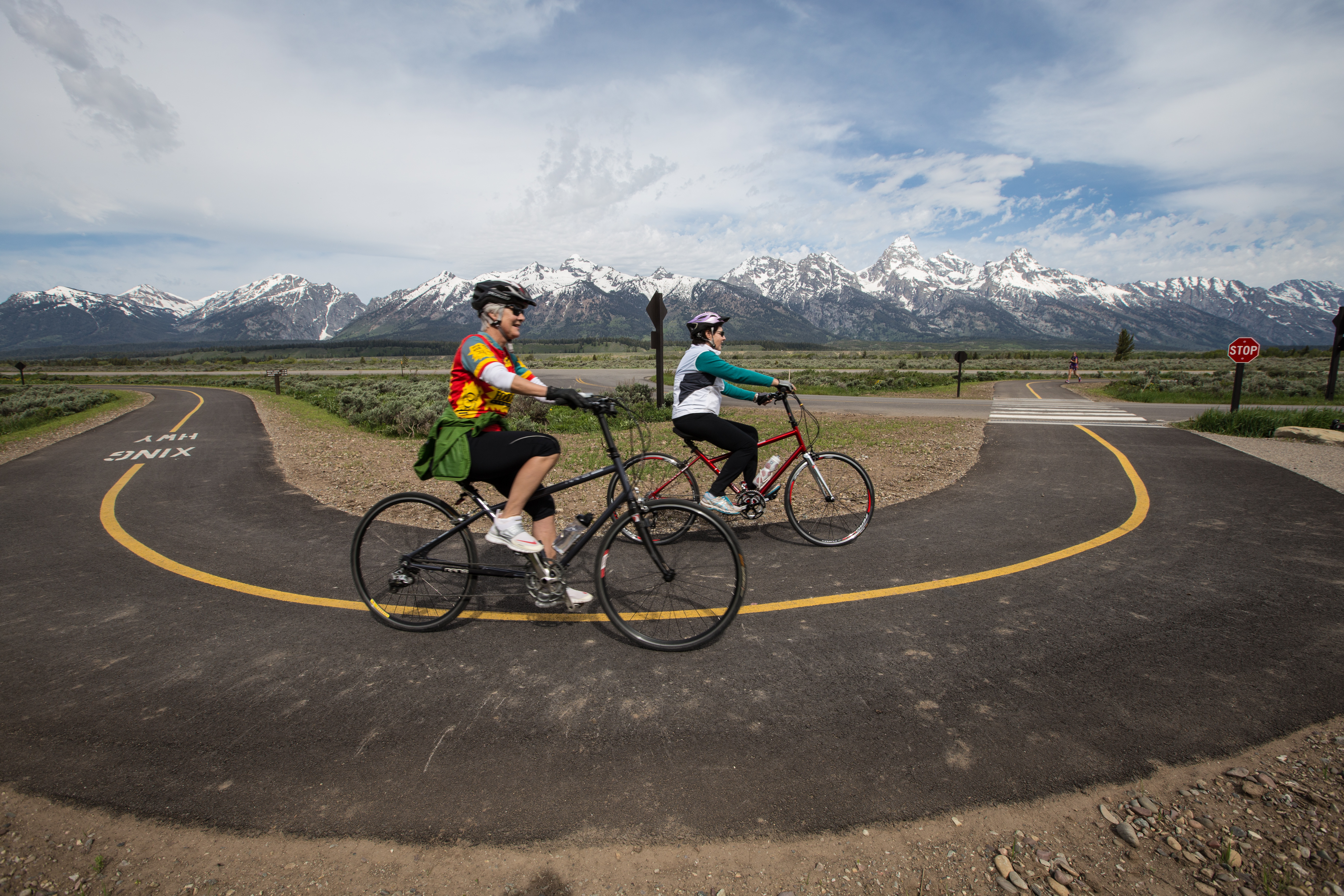
Grand Teton’s pathway system demonstrates a restriction based on time rather than bicycle technology. The park’s guidance says the pathway section along the National Elk Refuge between Jackson and Gros Ventre Road is closed from November 1 through April 30 for elk migration. Other sections depend on snowmelt and maintenance, and the park pathway is closed from dusk to dawn for wildlife and public safety.
Those distinctions are particularly relevant in early November. A photograph of riders under summer skies can accurately show the infrastructure while being a poor indicator of today’s access. Here, the photograph is an archival illustration of the pathway, not a condition report. The useful next check for a trip is the current park alert and route status, not the visual attractiveness of a past scene.


Reading the next announcement without losing the important distinctions
When another notice appears, the first question is its status: proposal, final regulation, local designation, or temporary operating notice. The second is its scope: the nationwide process or a specific location. The third is its date: publication, effective date, opening date, and seasonal access are not necessarily the same day.
For a specific ride, read the park’s current route rules rather than relying on the national proposal alone. Verify the bicycle class, speed restrictions, permit requirements, closures, and transit interactions. If a map and a general page appear inconsistent, seek the park’s current clarification instead of assuming the more permissive interpretation.
The November 2 deadline did not turn every trail into a bicycle route. The significant question now is how a future decision would connect a simpler administrative process to clear, evidence-based choices on the ground. The most useful outcome for visitors would be neither a blanket promise nor a blanket prohibition, but a route decision whose boundaries, reasons, and current conditions can actually be understood.

Sources and reporting method
National Park Service: Electric Bicycles in National Parks.
Acadia: Bicycling.
Mount Rainier: Bicycling.
Blue Ridge Parkway: Bicycle the Blue Ridge Parkway.
Zion: Bicycling.
Everglades: Biking.
Canyonlands: Biking.
Grand Teton: Biking in the Park.
National Park Service: Bike Safety.



Comments
Post a Comment