Widelands:
trade is not
a buy button.
A surplus becomes a commitment.
The economy must carry both.

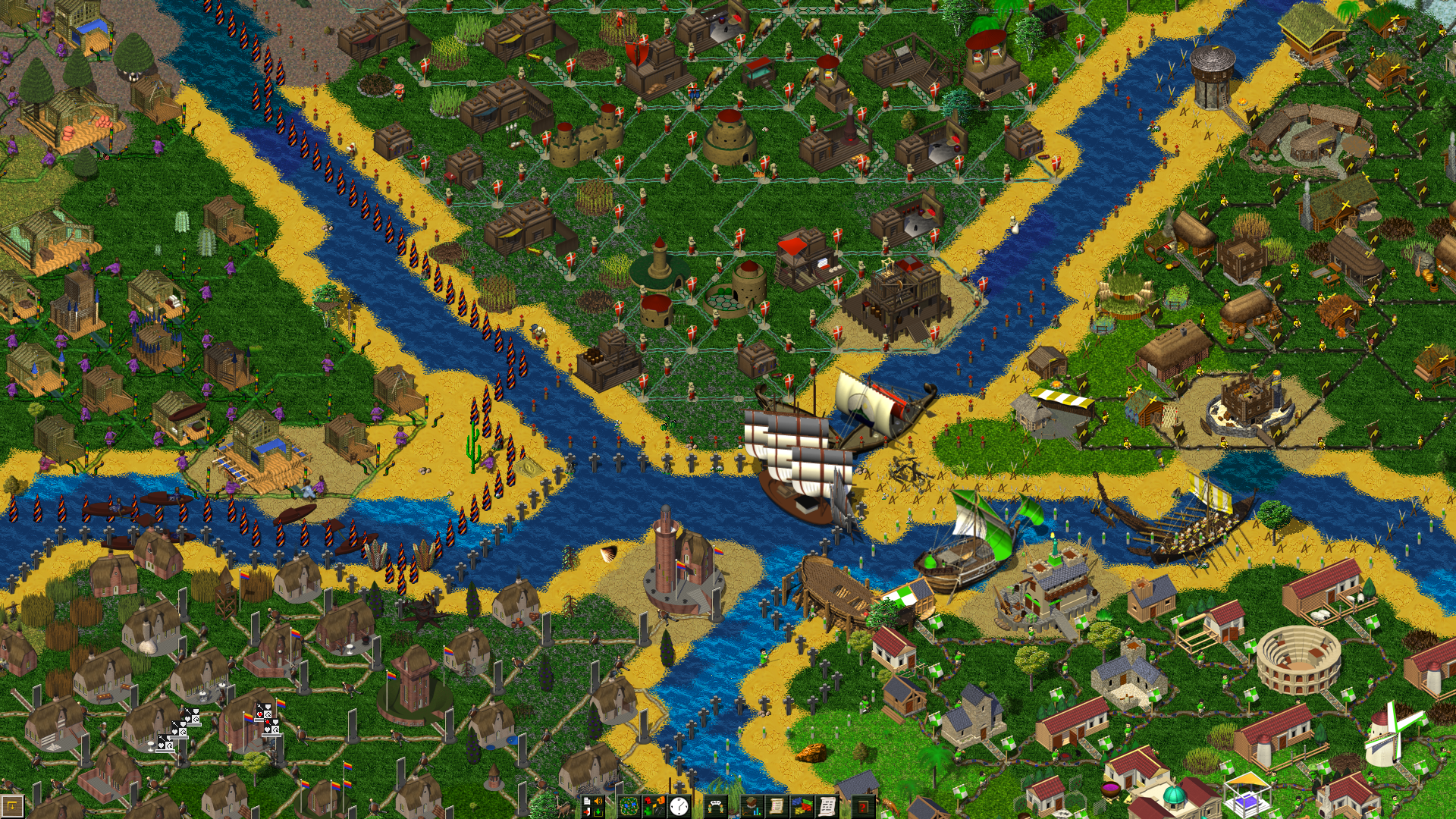
Widelands turns trade into a transport problem: a useful surplus still needs a partner, a route and a working supply chain.
The most revealing question in Widelands is not how quickly an army can cross a map. It is why a workshop has stopped producing when the settlement seems full of resources. The free, open-source strategy game's official economy tutorial directs players toward stocks, transport connections, production and consumption before inviting them to trade with another tribe. That sequence explains the appeal of its current stable release: economic decisions have to work as a network, not merely as numbers in a treasury.
Widelands 1.3.1, released February 22, 2026, remains the stable version identified by the project's official release channel at the time of this review. It is a corrective release, not a new October launch. The larger 1.3 update introduced market trading, economy districts and improvements to the in-game encyclopedia. This article examines those documented systems and the decisions they create; it is based on the developers' release records and tutorial materials, not a claim of a new hands-on performance test.
First, separate the feature release from the compatibility fix
The distinction between versions 1.3 and 1.3.1 matters most for multiplayer. The development team says 1.3.1 fixes a severe desynchronization problem found in 1.3 and explicitly states that the two versions cannot be combined in a network game. Friends planning a session should therefore check their actual version numbers rather than assuming that two installations labeled Widelands will necessarily work together.
The maintenance release does not represent a second introduction of markets. Those arrived with 1.3. The 1.3.1 changelog identifies a desynchronization fix associated with soldier launching and another correction to behavior after canceling a metaserver login dialog. Those are concrete maintenance changes. Describing the patch as an entirely new economic expansion would confuse what returning players need to know: the feature set and the reason to use the corrected stable build.
The official release supplies Windows packages for several architectures, macOS packages and a Linux AppImage, along with source code. A distribution repository or third-party package may update on a different schedule. Check the package's version and platform requirements rather than treating a download button as sufficient evidence. Development builds also exist, but the presence of ongoing commits is not an announcement that the next numbered stable release is complete.

The worker follows the system you build
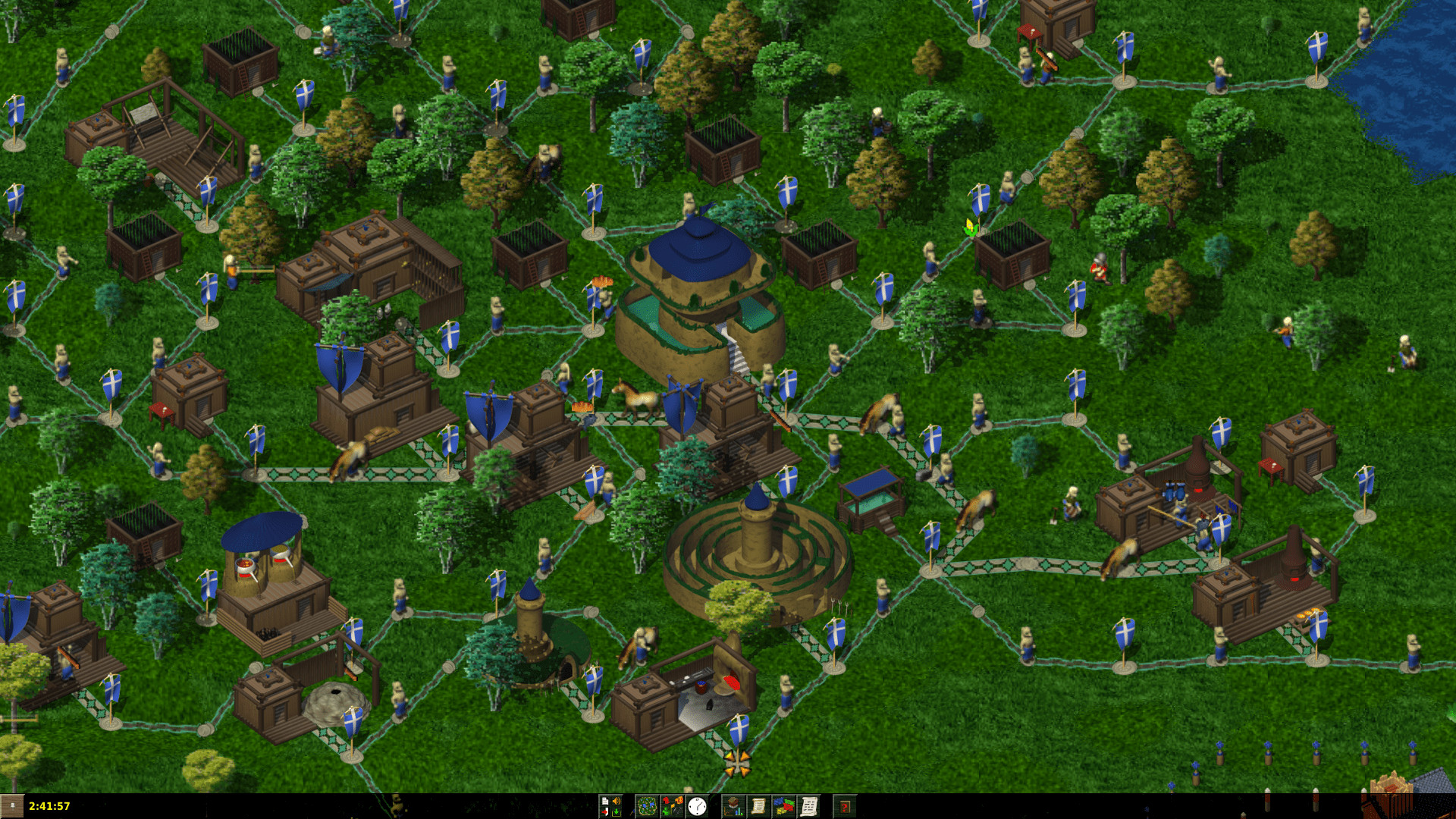
Widelands' economy tutorial begins with a useful limitation: players do not directly command each worker. Instead, they establish the conditions under which workers operate. Buildings, transport links, available inputs and production settings become the practical controls. That makes a nonproducing site a diagnostic problem. The answer may lie upstream or in the network rather than in the building itself.
For a player used to solving every shortage by adding another factory, this changes the first move. Another production site may compete for the same missing input, while a transport problem can leave resources available in one place but unavailable where they are needed. The game invites the player to examine a chain rather than issue a single command. Growth is useful only if the supporting system can sustain it.
The official tutorial treats building the economy and making it function as the central activity, not an administrative pause before combat. That gives the game a particular audience. Players who enjoy tracing causes through a simulation may find a stalled workshop more interesting than a rapid sequence of tactical orders. Those looking for constant direct unit control should understand that this is a different kind of real-time strategy rather than a simpler version of the same formula.
Players who enjoy tracing the missing link in a production network can compare this approach with our Factorio bottleneck guide, which works backward from a stalled machine through inputs, outputs and shared services.

A stock total is not the same as material in a warehouse
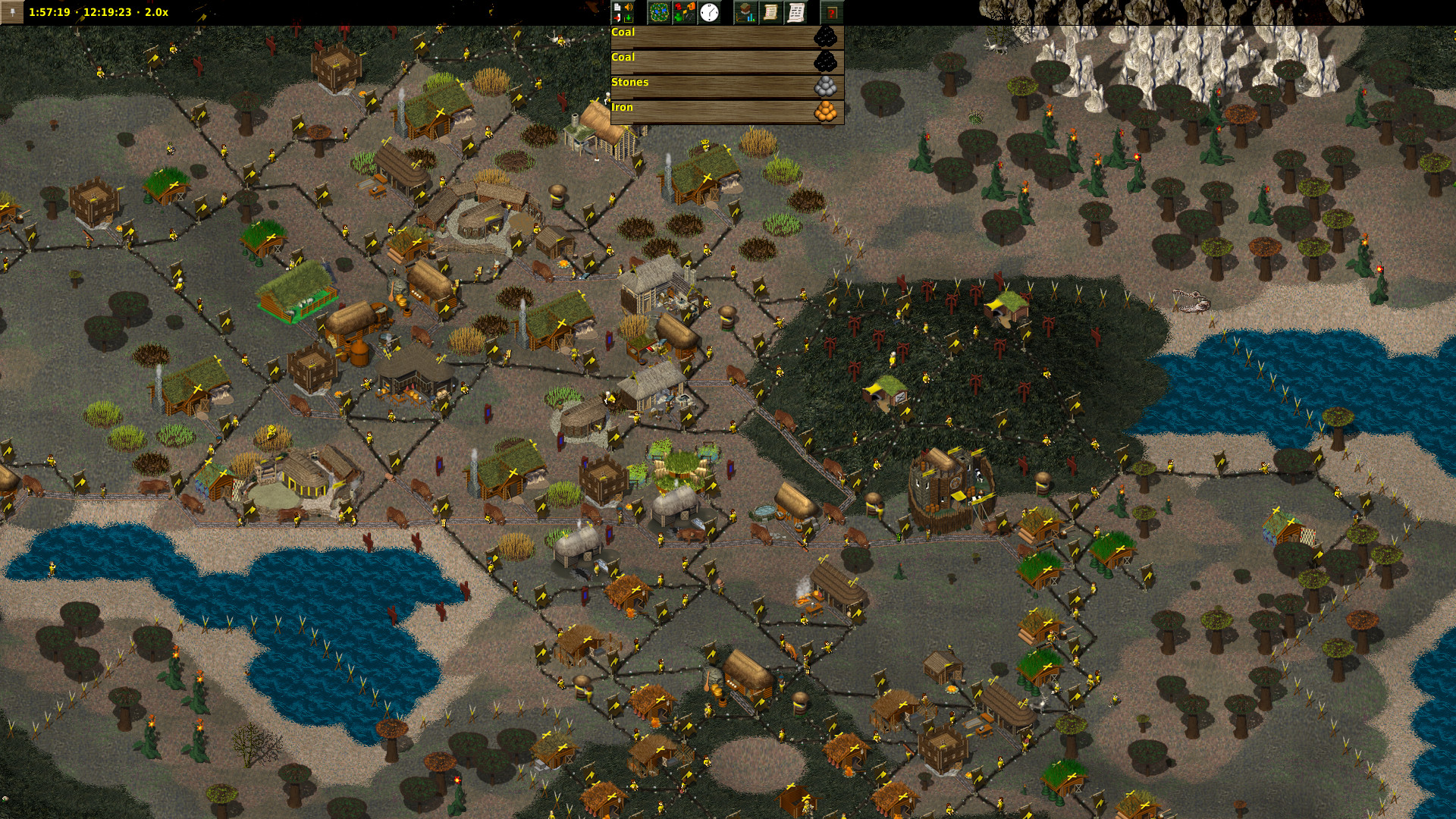
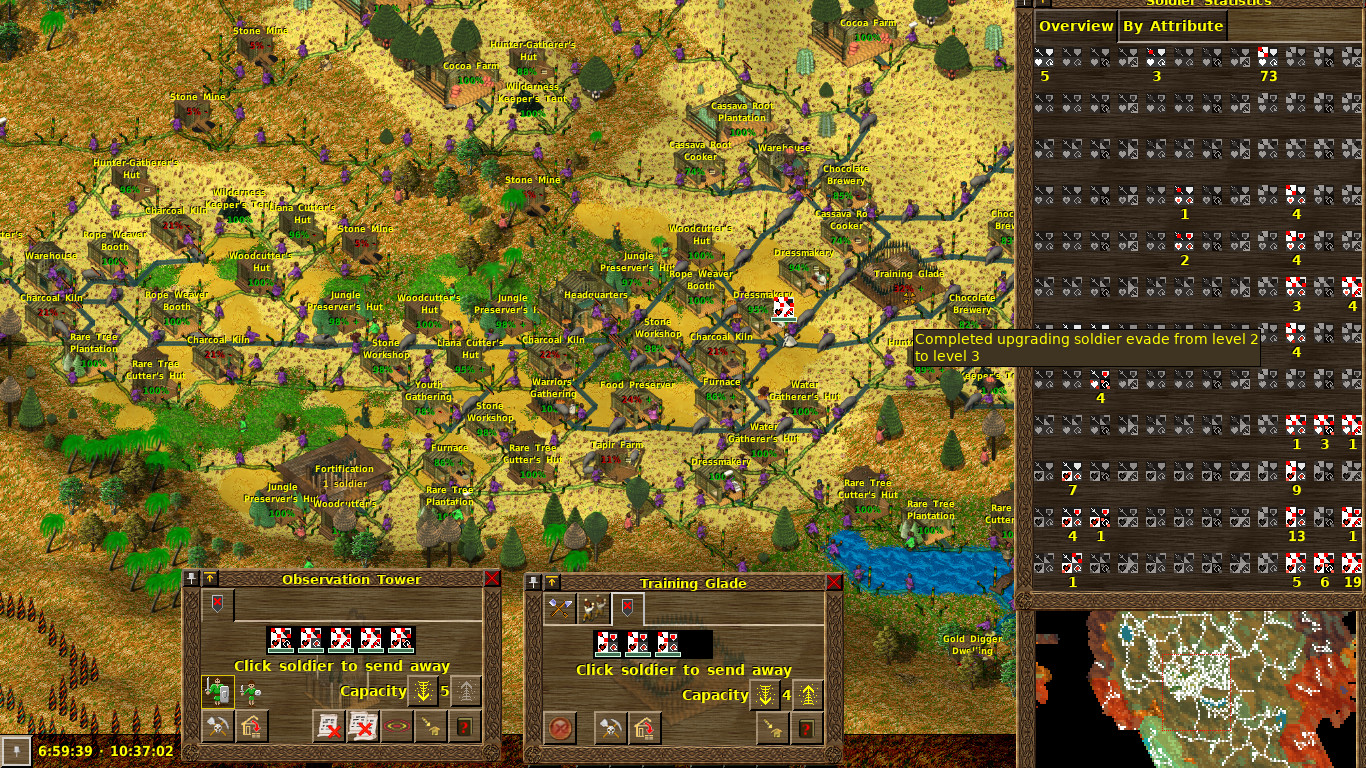
The tutorial's stock window distinguishes totals from storage. Its first tab includes wares on roads, at flags and inside buildings awaiting processing, not only items sitting in warehouses. That distinction matters when a player sees a reassuring total and assumes a resource is immediately available for a new project. Some of the material may already be in transit or committed to another stage of production.
Workers are also counted across roads and buildings. The interface is therefore a way to inspect an operating economy, not just a warehouse ledger. A shortage can be temporary movement through the network, insufficient production or a mismatch between what is being made and what current construction needs. Looking at the appropriate tab prevents one kind of count from being mistaken for another.
The practical habit is to ask where the bottleneck is before increasing the scale. If goods are being produced but are not reaching the relevant site, adding more of the same producer may not solve the immediate issue. If the economy is consuming a resource faster than it makes it, a large current stock may simply be concealing a decline. Widelands provides tools for distinguishing those situations, but the player has to read them together.

Economy health turns a pile of goods into a trend
The tutorial's economy-health view compares production and consumption. A positive result means that stock is growing; a negative one means it is shrinking. The absolute-stock graph answers a different question: how much remains. A large reserve and a healthy flow are not interchangeable, and a small reserve is not necessarily evidence of a system that is failing if production is increasing.
This is a stronger basis for a decision than reacting to one number in isolation. An economy can spend down an old surplus while appearing comfortable, or begin recovering before its storage total looks impressive. Comparing the trend with the remaining stock helps identify whether a shortage needs immediate intervention or whether a change is already taking effect. The game makes time part of the analysis.
The value of this interface is not that it predicts a universally optimal strategy. It gives the player evidence about the chosen network. Different maps, construction plans and tribes change demand. A useful review of Widelands should therefore avoid presenting one fixed building ratio as a solution to every settlement. The more transferable skill is learning to identify which flow is constraining the next objective.

Target quantities are reserves, not free production
The Configure Economy window lets players set desired quantities for wares. The tutorial explains that most production buildings respond when warehouse stock falls below a target. Setting a target therefore expresses the reserve the player wants; it does not instantly create material or remove the need for inputs, workers and transport. A higher number can change demand without solving the means of meeting it.
The tutorial illustrates the mechanism with tools used to create workers. If a farm needs a scythe and only one is available, starting another farm may have to wait while the toolsmith makes another. Keeping a larger reserve can make simultaneous expansion easier, but the reserve has to be produced in advance. The strategic choice is between using resources now to prepare capacity and leaving those resources available for other needs.
The same tutorial cautions against excessive stockpiling while recognizing the usefulness of buffers. It supplies economy profiles for different situations and an option for indefinite production. Those are controls to apply deliberately, not automatic upgrades. A warehouse full of one product may represent resources unavailable to another chain, while too little reserve can make a small interruption ripple through the settlement.

Geography matters even inside one settlement
The tutorial defines an economy through connected buildings and flags, linked by roads, ferries or ships. Separate networks can have different settings for wares. That means the map is not simply a backdrop on which globally interchangeable resources appear. Connectivity determines which system a particular building belongs to and which settings govern it.
Version 1.3 adds economy districts to that broader management toolkit. The release notes identify the feature, but this review does not turn that short description into an unverified step-by-step account of every district rule. The established tutorial already makes the underlying issue clear: where production occurs and how it connects to demand can matter as much as the total quantity produced.
One documented control permits a single production site to continue making a ware regardless of the broader economy target. The tutorial gives the example of producing building material near a border even when supplies are abundant far away. That is a concrete expression of the game's logistical focus. The relevant question becomes not only whether enough exists, but whether the material is in a useful location for the next task.

Markets exchange wares that both tribes can use
Trading begins with a market and a proposal to another player. In the official tutorial, the player chooses a partner, selects the wares to send and receive, sets quantities and specifies how many batches should be exchanged. The other player can accept or reject the proposal. The market is therefore an interface for an agreement, not a shop that automatically supplies any desired resource at a fixed universal price.
The list of available goods is constrained by the two tribes' economies. The tutorial explains that not every ware is useful to every tribe, so the proposal panel displays goods both sides can use. Its examples distinguish Imperial building and food requirements from Frisian ones. This prevents the attractive but mistaken assumption that any surplus can be traded for any shortage simply because both appear somewhere in the game.
That restriction gives knowledge of another tribe practical value. A good offer is not defined only by what the sender has too much of. It also depends on whether the recipient can use the item and what it costs that tribe to produce an alternative. The exchange system turns differences between tribes into potential cooperation rather than reducing those differences to visual styles or a set of interchangeable buildings.
A trade has a route, a batch and an ongoing commitment
The tutorial describes batches moving through the game world using trade carriers. It shows an Imperial caravan of donkeys and a Frisian caravan of reindeer carrying the agreed wares. The physical transfer is part of the system. A deal is not simply a simultaneous subtraction and addition in two abstract account balances with no logistical presence on the map.
Players can choose a fixed number of batches or make a trade indefinite. The market window then provides information about active trades and goods waiting to be exchanged. That creates a management question after the agreement is accepted: can the economy continue supplying the outgoing material without undermining its own plans? An indefinite arrangement deserves review when demand changes, just as a production target does.
The 1.3 changelog records controls for market input queues, capacities, priorities and pausing, as well as the ability to extend trades. These features matter because trade can become another claim on the same resources needed for construction and production. The system's interest lies in balancing those commitments. It is not evidence that every accepted bargain will remain advantageous regardless of later circumstances.
The diplomacy window keeps cooperation visible
The official tutorial separates team membership from trading: players do not have to belong to the same team to exchange goods. The diplomacy window provides an overview of proposals, offers and active trades, while individual markets manage their own transactions. If more than one market exists, the player chooses which market will handle an accepted offer.
This arrangement makes cooperation a set of decisions rather than a single alliance button. A player can examine a proposal, reject it, or route an accepted exchange through a particular market. The tutorial also allows multiple active trades with multiple players. Complexity grows through the number and location of commitments, not just through the size of a standing army.
The tutorial's example of exchanging Imperial meals for Frisian coal illustrates the economic logic without establishing a universal price guide. Production costs and usefulness differ between tribes and circumstances. The point is to recognize a complementary need, not to copy one ratio indefinitely. A mutually useful exchange can reduce pressure on each side, but only if both players understand what they are committing to provide.

The encyclopedia is part of the strategy interface
Version 1.3's release notes highlight improvements to the in-game encyclopedia, and the detailed changelog includes fuller worker-experience chains and revised performance descriptions for buildings. These are not cosmetic additions to a help menu. A game built around dependencies benefits when it explains those dependencies in the place where the player is making decisions.
The practical use is comparative: consult a building's requirements and role before assuming that a familiar-looking structure works identically across tribes. A production chain may depend on a particular ware, worker or transformation that is not obvious from the map view. Better documentation reduces the need to solve every uncertainty through blind construction, while leaving the strategic choice to the player.
The tutorial also encourages returning after some experience rather than understanding every control at once. That is a sensible way to approach a simulation with many interacting systems. Learn to read one shortage, connect one chain and manage one reserve, then revisit trade or more elaborate settings. The result is a progression through evidence and understanding rather than a demand to memorize an entire economy before beginning.

Maps and editors change the problem, not just the scenery
The 1.3 release brought six new maps and removed three older ones. It also integrated website maps with the add-on workflow and added editor visualization features, including a height heat map. These changes affect how players discover and inspect the spaces in which an economy operates. A different distribution of land, water and resources can make familiar production choices behave differently.
For returning players, the strongest reason to revisit Widelands is therefore not a claim that every screen has been reinvented. It is the way newer economic controls and trade build on an already tangible transport system. The next productive question may be why a reserve is falling, which network a building belongs to, or whether another tribe can supply something more efficiently. The game rewards connecting those questions into a working settlement.




Comments
Post a Comment