
SuperTux 0.7.0Read the
landing.
SuperTux 0.7.0 rewards more than fast jumping. Learn to read landing space, slopes, underwater routes and power-ups before committing to a move.
A familiar penguin, a different set of decisions
A bright strip of snow looks like an invitation to run. In SuperTux, it is also a diagram of what can go wrong next. A block hangs above the approach, an enemy occupies the landing, and the next shelf is separated by a gap. The mistake is not always a late button press. It can be choosing a jump without first deciding where the penguin should come down. That distinction makes this free, side-scrolling platform game worth approaching as a sequence of small spatial problems rather than a test of how continuously a player can hold right.
SuperTux 0.7.0 is the stable release highlighted by the project’s official download and release pages at the time of this report. The March 2026 update reworked story levels and introduced abilities including slope sliding, crawling and rock rolling. It also added an item pocket and local multiplayer. This is the platformer starring Tux, not the separately developed racing game SuperTuxKart. A shared penguin and an open-source background do not make their controls, save files or game rules interchangeable.
For an American household looking for something to play on a computer rather than another subscription, the useful starting point is the official download page. Choose the build for the actual operating system and hardware, not a package whose familiar name merely appears in a search advertisement. The project supplies platform-specific releases; this article is not a hardware benchmark or a promise that every controller works without configuration. Start with the game’s own controls menu and a short stretch of uncomplicated ground before making difficulty judgments.

The ten images accompanying this guide are the project’s actual 0.7.0 gallery screenshots. They show different situations, not a single level cropped ten ways. They are evidence of visible layouts and useful prompts for route analysis, not recordings of our own play. The movement advice below combines official documentation with editorial interpretation of those scenes. Where a still image cannot reveal a moving enemy’s cycle or the next screen, it cannot establish a guaranteed solution either.
Set up the actions, not just the jump button
The versioned 0.7.0 README supports both keyboard and gamepad play and directs players to Options, then Controls. Its essential vocabulary is compact: move left and right, jump, duck, action and item pocket. The action control can handle carrying objects or using a power-up, while the pocket stores one extra item. Knowing only movement and jump leaves part of the toolset inaccessible just when a narrow route or an awkward enemy makes it useful.
A practical first exercise is to separate three motions on safe ground. Make a short jump, then a more sustained jump, and finally a jump after an approach. The user manual describes holding jump longer to gain height. Watch the landing rather than merely the highest point. If two inputs produce different arcs, the important consequence is not a score for maximum height: one arc may fit beneath an overhang, while the other may reach an elevated shelf. Do not begin that experiment above a pit.
Put frequently paired controls where they can be pressed together comfortably. A keyboard arrangement that makes jump easy but duck and action awkward can turn an understandable obstacle into a hand-position problem. On a controller, verify the assigned buttons in the game instead of assuming that a particular console’s standard layout carries over. Change one mapping at a time and test it before entering a difficult stretch. That makes a failed attempt informative rather than ambiguous.
Returning players should also distinguish release documentation from older wiki material. The wiki’s Actions page contains historical descriptions and a separate proposed-abilities section. Some items once discussed as proposals appear in the 0.7.0 release announcement as implemented features. Treating every sentence on an old page as a current control specification would mix different stages of development. The versioned README and the controls visible in the installed release are the better anchors for setup.
Three things to locate before leaving the ground
In the opening snow scene, the useful objects are not equally important. First locate the surface that can support Tux after the jump. Then locate the obstacle that can intersect the arc. Finally decide whether the nearby item block or coins are part of this attempt or a later detour. This order prevents a collectible from becoming the destination when the real destination needs to be a safe piece of ground.
A landing zone has both width and timing. A broad shelf is forgiving when empty, but much less so if a walking enemy will occupy it as Tux arrives. Conversely, a narrow shelf may be manageable when approached from a predictable starting point. The screenshot cannot tell us the enemy’s exact speed. It can tell us that ground and opponent share the same corridor, which is enough to make observation before commitment a sensible choice.
The forest screenshot with overhead item blocks illustrates a related distinction between vertical reach and forward progress. A jump aimed upward at a block is not necessarily the same jump that clears the next obstruction. Combining both objectives too early introduces extra variables: the block changes the trajectory, the reward may emerge, and attention shifts away from the approaching ground. First establish how to cross the stretch. Then decide which block is worth revisiting or incorporating into the route.

This is not an instruction to ignore every coin. Collectibles can make a route legible, drawing the eye toward a passage or an arc. But a visible line of coins is not proof that the player’s current speed, position and power-up match the suggested path. In the snowy slope image, coins appear over hazardous ground. Read them alongside the shape of the slope and the far landing, not as an independent guarantee that moving toward them is safe.
Slopes are a commitment to what comes next
The gallery’s sliding scene is the clearest demonstration of why the approach matters. Tux is low on a long descent; the ground below the next section includes spikes. The hill offers movement, but the useful question is what happens when that movement reaches the bottom. Looking only at the character’s current location postpones the decision until the remaining room is already small.
Before beginning a descent, identify the transition at its foot. Does the surface continue, flatten, end at a gap or deliver the character toward a hazard? Decide where a jump belongs relative to that transition. This is route planning, not a claim about exact acceleration or a universal launch point. Those depend on the level and the current state of the character. A screenshot can demonstrate the relationship between slope, hazard and destination without supplying a frame-perfect input sequence.
If an attempt fails, classify it. Leaving the ground too soon can change the available distance; leaving too late can put the character into danger before the intended motion takes effect. Landing beyond the safe area is a different error from failing to reach it. Adjust one part of the approach and watch the result. Randomly changing both the starting position and the jump timing makes it much harder to learn which change helped.
The same reasoning explains why constantly maximizing speed is not a reliable beginner strategy. Momentum is useful when it serves a route. It is expensive when it carries the player into a section that has not yet been read. A deliberate pause on broad ground may produce a faster successful crossing than repeated attempts launched immediately after a restart. The relevant speed is progress through the obstacle, not the amount of time spent holding a direction.
Vertical routes and water change the map in your head
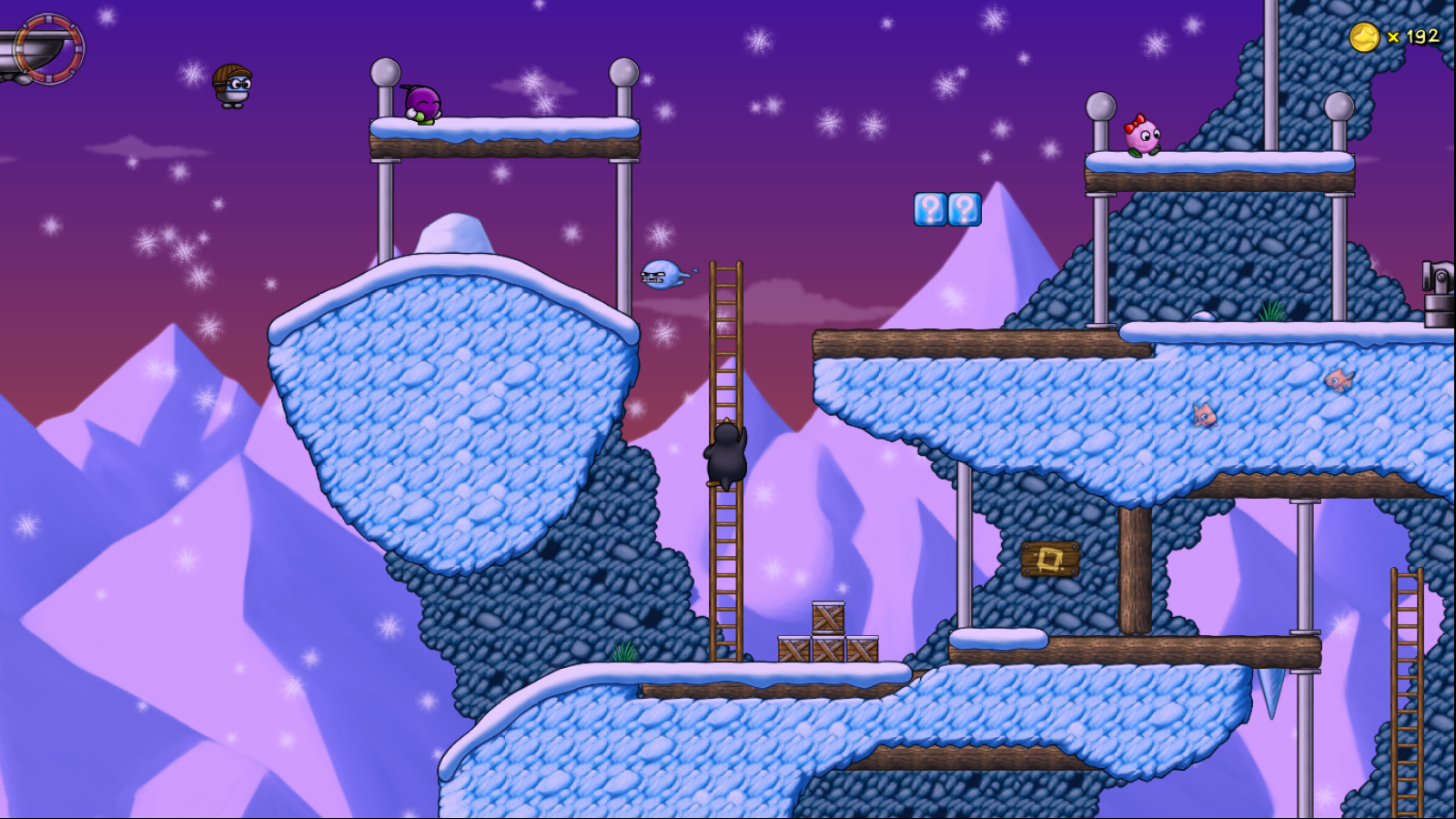
The purple-sky snow scene arranges platforms at several heights, with a ladder through the middle and smaller routes branching around it. This is not simply a horizontal corridor with a higher jump inserted. The player needs to connect intermediate positions. A good next destination may be a stable ledge that reveals another part of the route, even when it does not immediately move Tux far to the right.

Think in terms of staging points: a place from which the next move can be assessed without simultaneously correcting the previous one. On a vertical screen, the uppermost visible platform is not automatically the next target. Ask what connects to it, whether an enemy occupies the approach, and whether the current position provides enough room. The screen’s ladders and platforms are visual evidence of a layered route, not permission to assume every decorative structure is traversable in every level.
Underwater, the geometry becomes more open. The gallery shows a winding passage, fish, vegetation and a rock ceiling rather than a single floor. The official Actions documentation describes swimming as directional and momentum-based, with the jump input supplying a boost. That makes “go faster” a decision with a different cost: the route may bend, and the space above or below can matter as much as the space ahead.

A useful water exercise is to aim for the center of an open passage before accelerating through it. Leave room to correct the line rather than scraping along a boundary while trying to outrun uncertainty. Watch the destination of the next turn, not only the moving character. The underwater image does not prove which nearby creature is dangerous or how much clearance a specific turn requires; it does show why a land-based habit of looking only for a floor is incomplete.
A safe place now can be a dangerous place a moment later
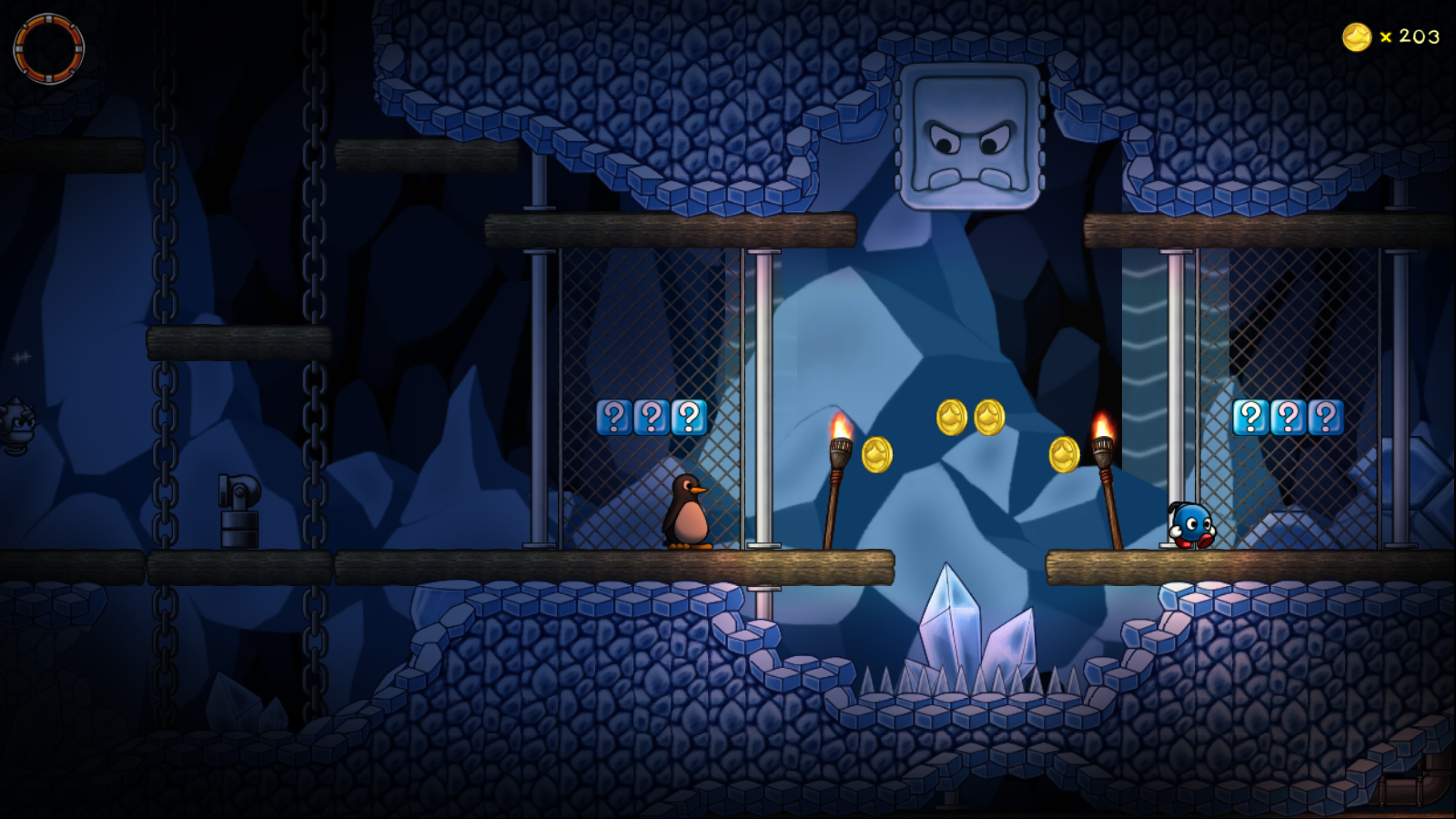
The cave screenshot puts a large suspended stone face above a gap between platforms. It is an especially useful warning against equating empty space with safe space. A hazard can threaten an area without occupying it continuously. The route must account for the volume an object may move through, not merely its position in a single frame.

Observe a cycle from a position outside the apparent path before deciding to pass. Separate the entry point from the exit point: reaching the middle of a dangerous span is not the same as clearing it. If the route asks for a jump, the player needs enough time and room for the whole action. If it asks for waiting, choose a place where waiting does not itself leave the character below a moving object or beside an approaching enemy.
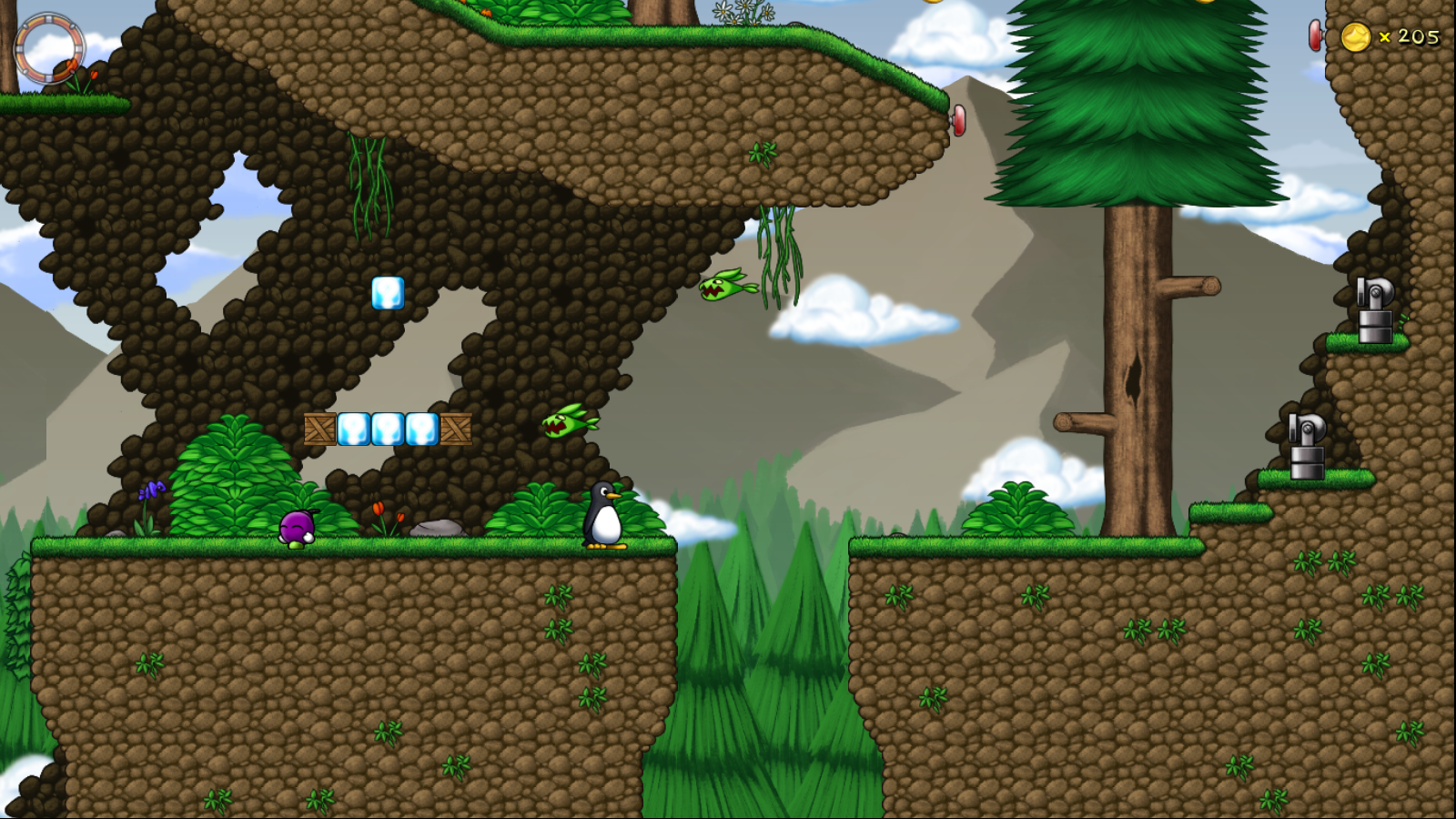
The nighttime forest scene adds a different kind of pressure. A flying creature appears above the path, ground-level objects occupy the lower route, and item blocks draw attention upward. It is easy to prioritize the most visually prominent feature and miss a threat on a different height. Read the screen in layers—ground, jump corridor and overhead space—then decide which layer the next motion will use.

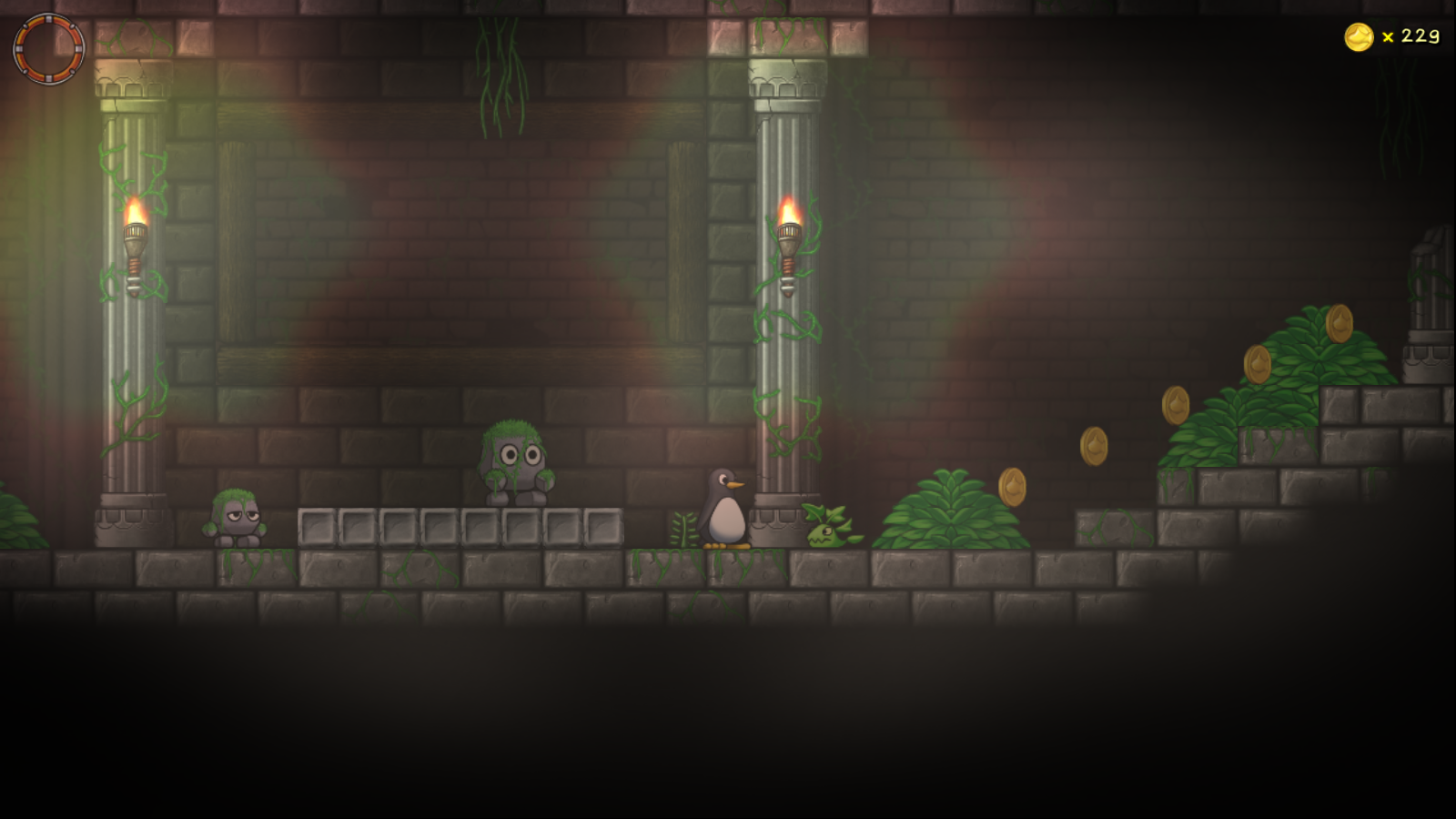
In the dim stone interior, the challenge is also visual. A lit area does not reveal the whole level, and decorative masonry competes with the actual walkable edge. Slow the interpretation down: identify the character, the supporting surface, the nearest opponent and the next clear patch. Avoid treating an unseen continuation as known ground. This is a reading strategy derived from the scene, not a claim that the game guarantees safety anywhere light is present.

Power-ups expand options; they do not remove the route
The manual distinguishes being hurt from falling out of the level. Power-ups can absorb some encounters, but they are not a general solution to every hazard. A player who becomes more willing to ignore the ground after gaining an ability can give up the very advantage that ability created. The practical value of a power-up is the set of additional actions it makes possible, not a license to stop looking.
The forest gap screenshot shows why. Tux stands near a break in the ground while enemies and objects occupy the surroundings. Even if an ability makes one opponent easier to handle, the gap remains a separate movement problem. Resolve the two questions independently: what interferes with the approach, and what movement reaches the far side? A successful attack does not establish a successful landing.

The item pocket makes preparation more explicit. The 0.7.0 README says it stores a single additional item. Before a demanding stretch, know which input uses it and what is currently available. Discovering that control during a fall is a poor test of the feature. Equally, do not assume a stored item gives an immediate answer to a route problem; its usefulness depends on the ability and the situation, not simply on its presence in the interface.
Objects deserve the same attention as enemies. The project’s Objects documentation describes carrying rocks and portable trampolines, using doors and switches, and activating checkpoints represented by bells. These are different kinds of interaction. A movable object can change access to a destination; a switch can change the level; a checkpoint changes where a failed attempt resumes. Looking for those roles broadens the question from “How high can I jump?” to “What can I change before I jump?”
Explore branches without turning every attempt into a checklist
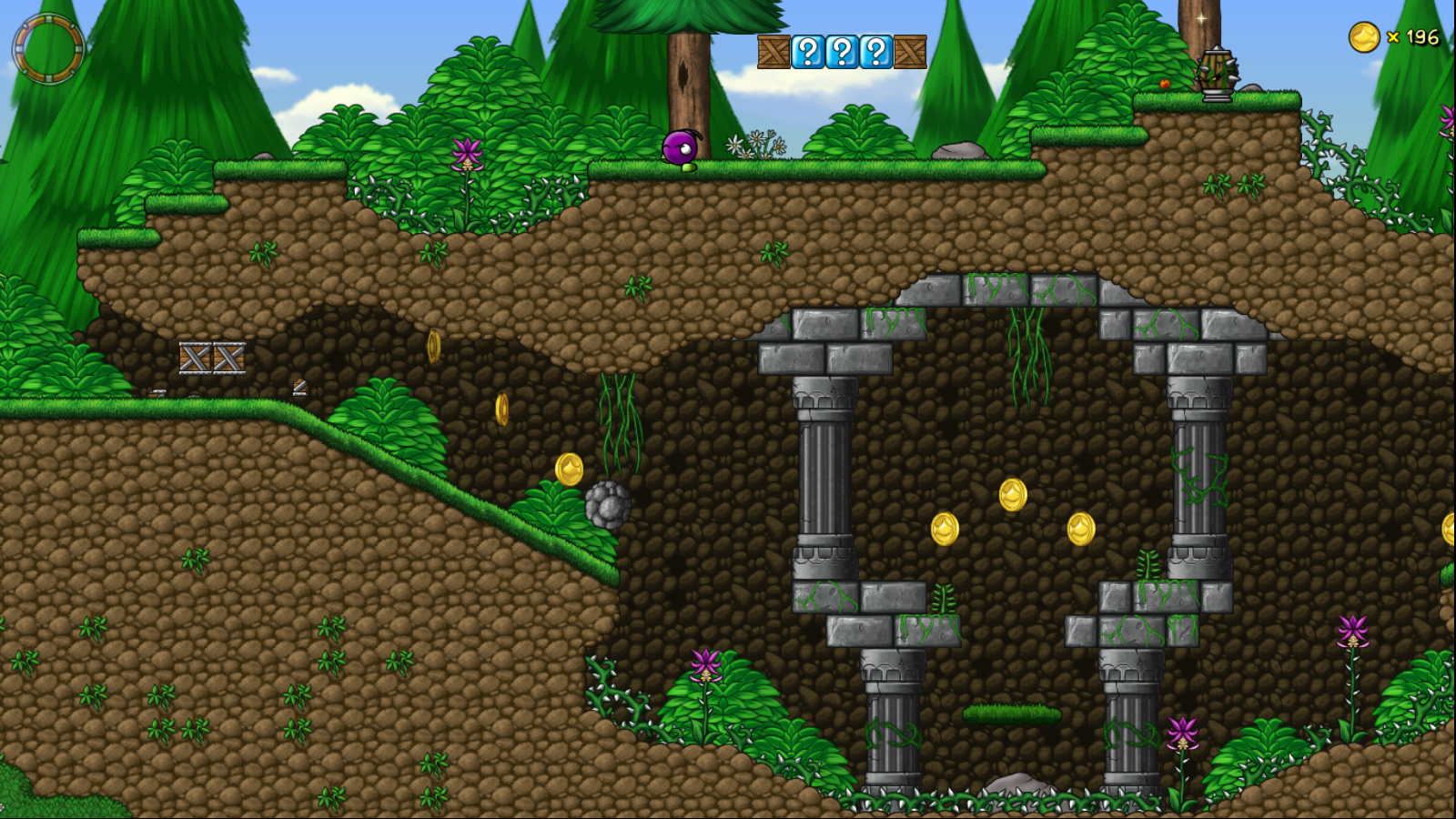
The forest ruins scene presents a broad upper route and a lower area framed by broken stonework, with coins distributed through the space. The image invites exploration, but it also illustrates how optional objectives can complicate a first crossing. Dropping into a lower branch changes the return problem. The player should look for a way onward or back rather than assuming that the shortest drop has a matching easy climb.

For a first pass, choose one objective: understand the main route, investigate one branch, or practice a troublesome move. Trying to complete all three at once makes the result difficult to interpret. A failed exploratory detour does not mean the main route is too difficult. A successful direct crossing does not mean every collectible has been located. Keeping those outcomes separate makes replay purposeful rather than repetitive.
The release announcement also changes the context for returning players: story levels and selected bonus content were reworked, and Tux Dolls are linked to unlocking bonus islands. Old route memories therefore need checking against the installed version. A guide for an earlier layout may still describe the general movement well while placing a collectible or obstacle somewhere that no longer matches the screen.
That is a reason to use version numbers when looking for help. Record the level name, installed release and the specific obstruction before searching. “The jump after the moving platform in version 0.7.0” is a more useful question than “the forest is impossible.” If asking a community for help, a screenshot showing the approach and destination communicates the problem better than a cropped close-up of the character alone.
Make a short session produce a clear result
A sensible first session is not a promise to finish an island. It is a sequence of tests with visible outcomes: confirm the controls, distinguish a short jump from a sustained one, identify one safe landing, and learn how to restart without losing track of the attempted route. Stop after understanding a particular obstacle if that is the available time. Progress can be a reproducible move rather than a new completion badge.
When sharing a computer, set controls deliberately before changing players. The release includes local multiplayer, but that fact alone does not establish a particular controller count, online mode or universal hardware compatibility. Check the installed game’s options for the intended setup. One person can also play while another describes the next landing or watches an enemy cycle; that simple division of attention requires no assumption about multiplayer features.
If an apparent control problem persists, distinguish input, performance and route understanding. A remapped button that does nothing is an input question. A scene that visibly stutters is a performance question. A jump that responds consistently but lands in the wrong place is usually a different question. Note the operating system, release, control device and reproducible steps when reporting a bug. Do not erase saves or change unrelated settings merely because a difficult section feels unresponsive.
Before upgrading an older installation, preserve its saves. The 0.7.0 release notes warn that older story-mode saves are invalidated and backed up, and that beta saves require attention; the developers encourage a fresh start. Do not treat a familiar filename as proof of compatibility, and do not overwrite the only copy while experimenting. The point of a fresh route is to learn the revised game, not to turn a leisure session into an avoidable recovery job.
SuperTux becomes easier to understand when the next landing is the center of attention. The snow slope, underwater bend, suspended cave hazard and branching forest each ask a different question. Learn to name that question before acting. Then the jump button becomes the final step of a decision already made, rather than the beginning of a guess.




Comments
Post a Comment