
Wesnoth:
win the
next turn.
Battle for Wesnoth rewards planning beyond one attack. Choose the stable branch, read the terrain and leave room for a bad roll.
The first decision happens before the first battle
Battle for Wesnoth rewards planning beyond one attack. Choose the stable branch, read the terrain and leave room for a bad roll.
The Battle for Wesnoth is a free, open-source, turn-based fantasy strategy game, but its most interesting demand is neither a reflex test nor a build-order race. It asks players to commit to positions while accepting that combat can go wrong. The useful question is not simply whether an attack is likely to succeed. It is whether the army can survive the turn after it fails. That distinction changes how a newcomer should read almost every attractive opportunity on the map.
As checked on October 21, 2026, the project's download page lists 1.18.8 in its stable branch and 1.19.28 in development. Those numbers describe different tracks, not a simple contest in which the larger number is automatically the better choice. The project recommends stable releases for most players and warns that development releases may bring bugs or performance problems. For a first campaign, a predictable environment is more useful than access to unfinished changes.
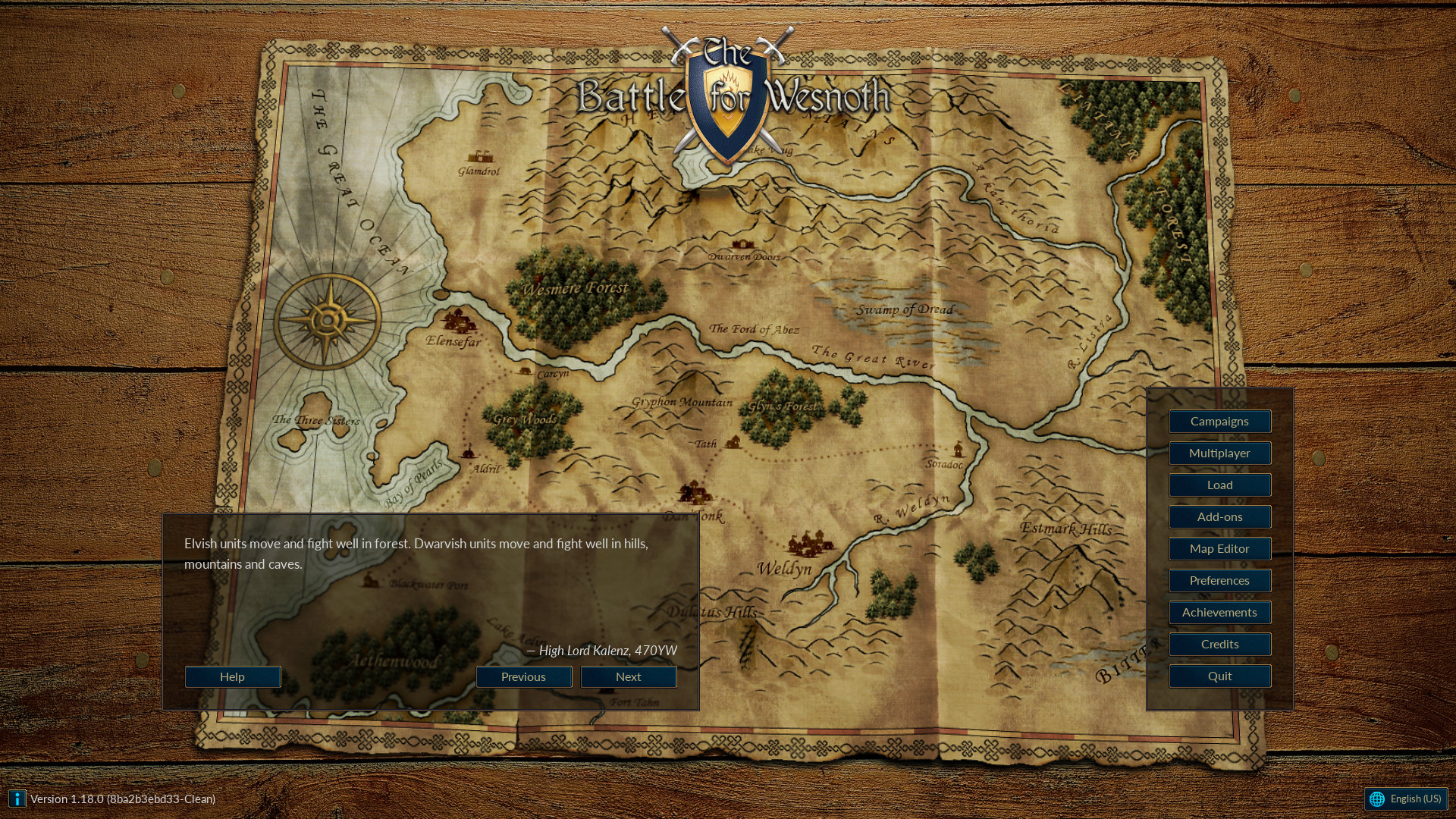
This is an analysis of the project's current download guidance, manual and strategy documentation, not a hands-on review or a claim to have completed its campaigns. The official screenshots reproduced here show version 1.18.0, with one clearly labeled 1.16.0 comparison. They illustrate the game's interfaces and tactical geography; they are not images of a newly released 1.18.8 scenario. That distinction matters when checking whether a menu, campaign or add-on on your own installation matches an illustration.

Choose a campaign by its commitment, not its prestige
A campaign connects scenarios and allows surviving units to become part of a continuing force. A stand-alone multiplayer scenario creates a different decision environment: a veteran saved for a hypothetical later chapter has no value if there is no later chapter. Before evaluating a unit or taking a risk, decide which kind of game you are actually playing. Campaign advice and competitive multiplayer advice can share mechanics without sharing priorities.
Use the tutorial to learn controls, then read the campaign selector's own description and difficulty choices. A short introductory campaign is a better diagnostic than an ambitious epic: it reveals whether you enjoy managing movement, counterattacks and persistent casualties without requiring a large initial commitment. The official campaign catalog gives A Tale of Two Brothers a four-scenario structure. Length is not the same as ease, but it is a concrete way to size an evening's learning project.
The scenario objectives deserve the same attention as the map. An instruction to survive, reach a location or protect a named unit is not equivalent to an instruction to destroy every opposing leader. A player who treats every map as total conquest may spend scarce turns and expose valuable units for a result that the scenario never requested. Read both victory and defeat conditions before recruiting, then revisit them when a story event changes the situation.
This suggests a practical way to choose your first difficulty: choose the setting on which you can understand why a plan failed. An easier campaign can still teach terrain and sequencing; a harder one does not automatically teach more if repeated defeats obscure the cause. The goal of a first run is a readable feedback loop, not a performance claim. There is no reason to turn a single-player difficulty label into a test of belonging.

A hex has more than one price
Wesnoth's terrain is an active part of combat. Movement cost determines how far a particular unit can travel, while terrain defense affects how readily attacks connect. Resistance is another property again: it changes damage from a particular attack type. Treating these as one generic armor statistic conceals the choices that make the board interesting. The same forest, river or hill can be an opportunity for one unit and a trap for another.
Consider a hypothetical advance toward a village. A route that looks shorter on the screen may consume more movement because of the terrain it crosses. A route with fewer movement costs may leave the unit on an exposed final hex. Neither route is automatically correct. First determine where the unit can actually finish, then inspect its defense there, then consider which enemies can approach. The destination, rather than the apparent straight-line distance, is the relevant unit of planning.
The official strategy guide's forest-edge example captures the principle: elves can benefit from defending in forest while an attacker must occupy less favorable adjacent ground. The lesson is not that forests are always superior. It is that an engagement includes two positions, not one. A strong defensive hex is less useful if reaching it requires exposing a critical unit or abandoning the objective. A favorable attack also needs a credible route back into a formation.
For a US PC player arriving from games with broad cover bonuses, the useful adjustment is to inspect the selected unit's actual terrain information rather than memorize a universal landscape ranking. Build a habit of reading the unit and the hex together. The map's beauty can then become information: a shoreline is a change in movement possibilities, a forest edge is a possible defensive boundary, and an open approach is an invitation to ask who must stand there first.

The combat forecast is a range, not a promise
An attack's displayed damage and number of strikes do not mean that all of that damage will occur. Hit chances make the outcome variable. Some weapon specials modify normal expectations: the manual says magical attacks have a 70 percent chance to hit regardless of the defender's usual terrain defense, while offensive marksman attacks have at least a 60 percent chance. Read the actual preview because weapon specials, resistances and other modifiers can change a matchup.
A small mathematical example explains why a seemingly reasonable attack can still disappoint. Imagine four independent strikes, each with a 60 percent hit chance, and assume nothing changes those probabilities during combat. The expected number of hits is 2.4, but exactly one hit has a probability of 15.36 percent and no hits has a probability of 2.56 percent. Together, one or fewer hits happens 17.92 percent of the time. This is an illustrative calculation, not a claim about a particular unit or screenshot.
Expected damage is useful for comparing options, but it is not a guaranteed health reduction and does not describe the cost of failure. If a plan requires exactly enough hits to remove the only enemy threatening your leader, the downside can be much larger than the difference between two average-damage estimates. Ask what remains possible after an unfavorable result: a second attack, a blocking unit, a retreat, or simply accepting that the target survives.
The reverse is also important. A failed attack does not prove the choice was irrational. Judge a decision by the information and alternatives available before combat, then examine whether the plan tolerated a plausible bad result. Repeatedly replacing that judgment with the last visible outcome encourages two mistakes: blaming every loss on luck, or assuming a successful gamble was safe. Wesnoth is more legible when probability informs the plan rather than excuses it afterward.
Night changes the value of waiting
Time of day affects units according to alignment. The standard cycle has six turns: dawn, morning, afternoon, dusk, first watch and second watch. In the usual schedule, lawful units receive a daytime damage bonus and a nighttime penalty; chaotic units have the opposite relationship. Neutral units do not receive those ordinary day-night adjustments. Other alignments, abilities and scenario schedules require reading the local information rather than assuming the default.
The manual's standard table gives lawful units a 25 percent daytime bonus and a 25 percent nighttime penalty, with the pattern reversed for chaotic units; dawn and dusk are neutral transitions for those two alignments. These are damage adjustments, not additional movement and not a blanket increase in hit chance. That separation prevents a common planning error: treating a favorable hour as if it fixes a poor position or makes an unreliable attack certain.
Because opponents act after your turn, a good attack window must be evaluated across the transition. An advance late in a favorable period may leave the force exposed when conditions change. Conversely, a defensive pause can be productive if it lets wounded units recover while the enemy's advantage expires. Waiting is not the same as doing nothing when it changes the circumstances of the next engagement.
The practical routine is to inspect the current time and the next phase before committing the front line. Ask whether a unit must hold its final hex through an unfavorable response. If so, positioning, support and remaining health deserve more weight than the damage it can deal immediately. A campaign's turn limit still matters, so retreating forever is not a strategy. The point is to spend time deliberately rather than discover its cost after ending the turn.
Keep a way out before you create a way through
Zone of control is the rule that turns individual units into a formation. Under the standard rules, a unit of level one or above affects its six neighboring hexes, and an enemy entering that area generally stops moving. Skirmishing is an important exception. The rule does not make the front line invulnerable, but it means that a few carefully placed units can protect spaces behind them without occupying every possible tile.
A breakthrough therefore has a second price beyond the attacking unit's health. Moving a defender forward may open an approach to a healer, a wounded veteran or the leader. The attractive target directly ahead is only one part of the board. Before committing, use the enemy-movement display and consider the routes that become available if one of your exposed units is defeated. A formation that works only while every front-line unit survives is more fragile than it looks.
Reserves make that geometry repairable. A healthy unit held behind the line may seem unproductive when counting this turn's attacks, yet it can replace a damaged defender, close a gap or exploit an unexpected success. Its value is flexibility. The official guides discuss rotating wounded units away from the front; the underlying lesson is to preserve both a replacement and a destination before the rotation becomes urgent.
This is why a compact group is not simply a blob of units. Its shape determines how many enemies can attack a particular defender and whether supporting troops can move when needed. A corner or flank may be more exposed than the middle. Do not apply a tidy formation diagram mechanically to rivers, mountains or a timed objective. Instead, ask what the formation protects and which specific loss would break it.

A village is income, recovery and a possible distraction
Villages connect the tactical map to the economy. They contribute income and provide healing, while maintaining units creates upkeep. The manual describes basic upkeep in relation to unit level, with exceptions such as loyal units, and explains how village support affects the bill. The relevant question is not merely how much gold is currently in the treasury. It is how the army's recurring costs compare with the territory it can realistically hold.
A fast unit can claim distant villages, but ownership at one moment is not the same as a sustainable advantage. If a scout is stranded, if the route back is cut, or if securing one village pulls the main force away from a time-sensitive objective, a small apparent gain can carry a larger strategic cost. Evaluate the capture together with the next turn's movement and the opponent's likely response.
Healing makes villages attractive in another way, but it also makes them predictable destinations. A wounded unit should reach a location where it can recover without becoming an easy target, not merely reach the nearest village icon. The manual explains that poison and healing interact differently from ordinary damage recovery; a poisoned unit's needs cannot be reduced to the same calculation as a healthy unit missing a few hit points. Check abilities and status effects before arranging support.
The broader lesson is that economy and tactics are not separate phases. Recruiting more units can strengthen a front while reducing future income. Keeping an experienced unit alive can avoid a difficult replacement journey. Capturing a useful healing location can shorten the time a portion of the army spends out of action. Compare these consequences rather than optimizing a single visible number in isolation.

Veterans are a roster, not a museum collection
Campaign persistence makes experience valuable. Units that survive can be recalled in later scenarios, and advancement can change their capabilities. The official strategy guidance encourages developing a force that can meet later challenges rather than distributing every opportunity without a plan. A balanced roster, however, is not necessarily a collection of the highest-level units available. The next scenario's terrain, enemies and budget can make a specialist or inexpensive recruit more useful.
Giving a nearly defeated enemy to a unit close to advancement can be a sensible investment, but the finishing attack still has to be safe enough to attempt. An experience plan that exposes the learner to a lethal counterattack is not automatically efficient. Check whether another unit can cover the position, whether the attack can fail, and whether the advancement actually supplies a capability the army needs.
There is also a psychological trap in persistent campaigns: protecting a favorite veteran so carefully that it never contributes, or risking the entire force to avoid losing it. The official beginner advice recognizes that casualties are part of the game. The useful distinction is between a loss that advances the objective and one caused by an avoidable exposure. Preserving every individual at any cost is not the same as preserving the campaign's ability to continue.
Recall decisions become clearer when framed as jobs. Who can hold the difficult terrain? Who can deal with a resistant enemy? Who can support injured units? Who can reach the remote objective? Those questions produce a force with a purpose. Selecting familiar portraits first and trying to invent a plan afterward reverses the reasoning, even if the recalled units are individually impressive.
The official achievements screen shown here lists additional goals for multiplayer survival scenarios. Such goals can provide another reason to revisit content, but they should not be confused with every scenario’s immediate victory condition. Read the actual objective first; an optional completion target is a different kind of commitment.

Multiplayer begins with agreement about the game
Online play adds other people's time and expectations to the tactical problem. The official download guidance says releases within the stable branch are compatible with one another and identifies that branch as the main player community. Development is a separate track. Before arranging a game, check the branch, map, era or add-ons, victory conditions and any turn timer. A mismatch discovered in the lobby is easier to fix than a misunderstanding halfway through a match.
Start with a scope everyone can complete. The number of sides, map size and decision timer all affect the practical commitment, but no single duration estimate fits every game. Do not promise a short session merely because the interface looks simple. A small practice scenario against an AI or a familiar partner can teach movement and counterattack reading without the pressure of an unfamiliar competitive room.
Campaign habits may need adjustment here. A multiplayer opponent can recognize a diversion, decline an unfavorable exchange or exploit a conspicuously unguarded leader. Advice about tricking an AI is not a dependable promise against a person. Equally, a dramatic tactical win in one match is not evidence that a faction is universally strongest. Map, matchup, settings and player decisions all affect what the result can support.
The most useful postgame question is specific: which information did you fail to use before a commitment? Perhaps the next time-of-day phase was unfavorable, a skirmisher bypassed the intended screen, or recruiting left the leader unable to reach the front. A review framed around one identifiable decision is easier to act on than a sweeping claim that the whole game was decided by luck.

Add-ons expand the game, but they are not all the same product
Wesnoth supports community-made campaigns and other content, and its add-on interface makes that ecosystem visible. An add-on can change the experience substantially, including the available units or scenario rules. Treat its description, compatibility and maintenance information as part of the selection process. Being downloadable from a community catalog does not mean it has the same balance, scope or intended audience as the built-in campaigns.
For a new player, one controlled change at a time is more informative than installing a large collection immediately. Learn the base mechanics in a known campaign, then choose an add-on because it offers something specific: a different story, a cooperative structure or a new set of tactical constraints. If the result is confusing, you will have a clearer sense of whether the difficulty comes from Wesnoth itself or from the additional content.
The project has explicit licensing requirements for contributions, but licensing and editorial suitability are different questions. A reusable asset or freely distributed campaign can still be unfinished or simply not match your preferences. Likewise, open-source status does not guarantee that every package on every platform is updated at the same moment. Use the project's current download and compatibility guidance instead of relying on an old third-party installation tutorial.
This is a place where restraint improves the first session. A modest, understood setup gives the player a baseline against which to judge new content. The appeal of a long-running community game is not that everything must be explored at once. It is that there can be another campaign or mode when the current one has taught you what you wanted to learn.

The editor reveals why maps are arguments
The map editor is not only a tool for aspiring campaign authors. Its existence points to the importance of deliberate geography. A river with one crossing, a wide field between castles and a cluster of villages near difficult terrain create different strategic pressures. A map is therefore not a neutral stage onto which units are placed. It distributes opportunities, bottlenecks and costs before either player makes a move.
You do not need to publish a map to learn from that idea. When entering a new scenario, identify the routes that connect the starting area to the objective, then distinguish the route a fast unit can use from the route the whole army can sustain. Look for places where a small defensive force can hold a larger one, and for alternative approaches that prevent a single crossing from becoming the entire plan.
The archival 1.16.0 screenshot below is useful precisely because its bridge and river remain readable without presenting it as a current-version feature announcement. It illustrates a persistent spatial question: who must cross unfavorable ground, and who can wait on the other side? The exact unit balance or scenario state should not be inferred from an old image. The visual is evidence of layout, not a substitute for checking the current rules.
A better first evening: learn one complete decision cycle
A focused first session can follow a simple sequence. Confirm the stable download for your platform, run the tutorial, choose a short introductory campaign and read its first objective. Before each important attack, inspect the destination terrain, combat preview, next time-of-day phase and enemy reach. After combat, repair the formation before using every remaining unit to chase damage. The order matters because later decisions depend on the positions earlier ones leave behind.
When a plan fails, return to the earliest decision that made recovery difficult. It might be a recruitment choice, a needless crossing, a missing reserve or an attack that required an unusually favorable result. That diagnosis is more useful than replaying the last attack until it happens to work. Saving and reloading are available tools in a single-player game, but they teach more when used to compare plans rather than simply search for a different roll.
Wesnoth's attraction is the tension between visible rules and uncertain outcomes. Its turn-based pace gives players time to inspect the board, yet it never removes the need to commit. The strongest beginner habit is therefore not memorizing a perfect army. It is building a plan that remains coherent after an imperfect exchange. Win the current fight when it serves the objective, but leave enough structure to play the next turn.




Comments
Post a Comment